
No one becomes a shaman simply by studying. A shaman is called to his task by helping spirits and by the souls of the ancestors, who act through him. The calling often comes as a grave illness that brings him to the threshold of death. In that state, spiritual powers dismember him, test him, and only his return from the borderland of death gives him the power to heal. Some of those who are called do not survive the descent. In that world, death is not an end, but a threshold one passes through, and so these beings are not troubled by it. Whoever descends and returns brings back knowledge from the other side.
Mircea Eliade documented this pattern across many cultures as the initiatory illness. The future shaman falls ill, enters a state close to death, undergoes the dismemberment and reassembly of his own body, and returns transformed. What psychiatry may describe as disintegration, traditional culture understands as initiation. The difference lies not in the experience itself, but in whether a culture has a name for it.
The Archetype
The archetype of the wounded healer tells us that the ego must be broken open so that a deeper layer within us can emerge. The Latin word innocens means one who has not yet been wounded. Innocence is the state before the first wound: outwardly whole, yet inwardly untested. An encounter with what transcends us wounds the ego, because it takes away the illusion of self-sufficiency.
In his book Wetiko, Paul Levy connects this archetype with shamanic initiation, and also with his own experience in 1981, when his psychological breakdown was diagnosed as psychosis. In reality, he was passing through an initiatory process for which psychiatry had no language. From this, Levy draws a principle of direct importance for anyone who heals. The symptom carries the signature of what remains unresolved, and at the same time it opens a way in. Illness, in his view, is the organism’s attempt to heal itself.
Christianity takes the image of the wounded healer to its furthest extreme, because in Christianity it is God himself who descends. Through incarnation, God enters matter. Through death, he descends among the dead, to the deepest point of the fall. Through resurrection and return to the source, he brings with him what he descended to raise. Christ is the most radical form of the wounded healer, because in him the healing of the world comes through the wound and through descent into the lowest place.
Why the Descent Is Necessary
The world is the place in which the soul is brought to maturity. According to Irenaeus of Lyons, the human being is unfinished. Through experience, we are meant to grow into our full form. In the twentieth century, John Hick called this line of thought the “vale of soul-making.” A world in which we encounter resistance and pain is the only environment in which the soul can mature into a free relationship with the source. In a comfortable world without weight or difficulty, such depth would never arise. It is born only through struggle, through resistance, and through suffering.
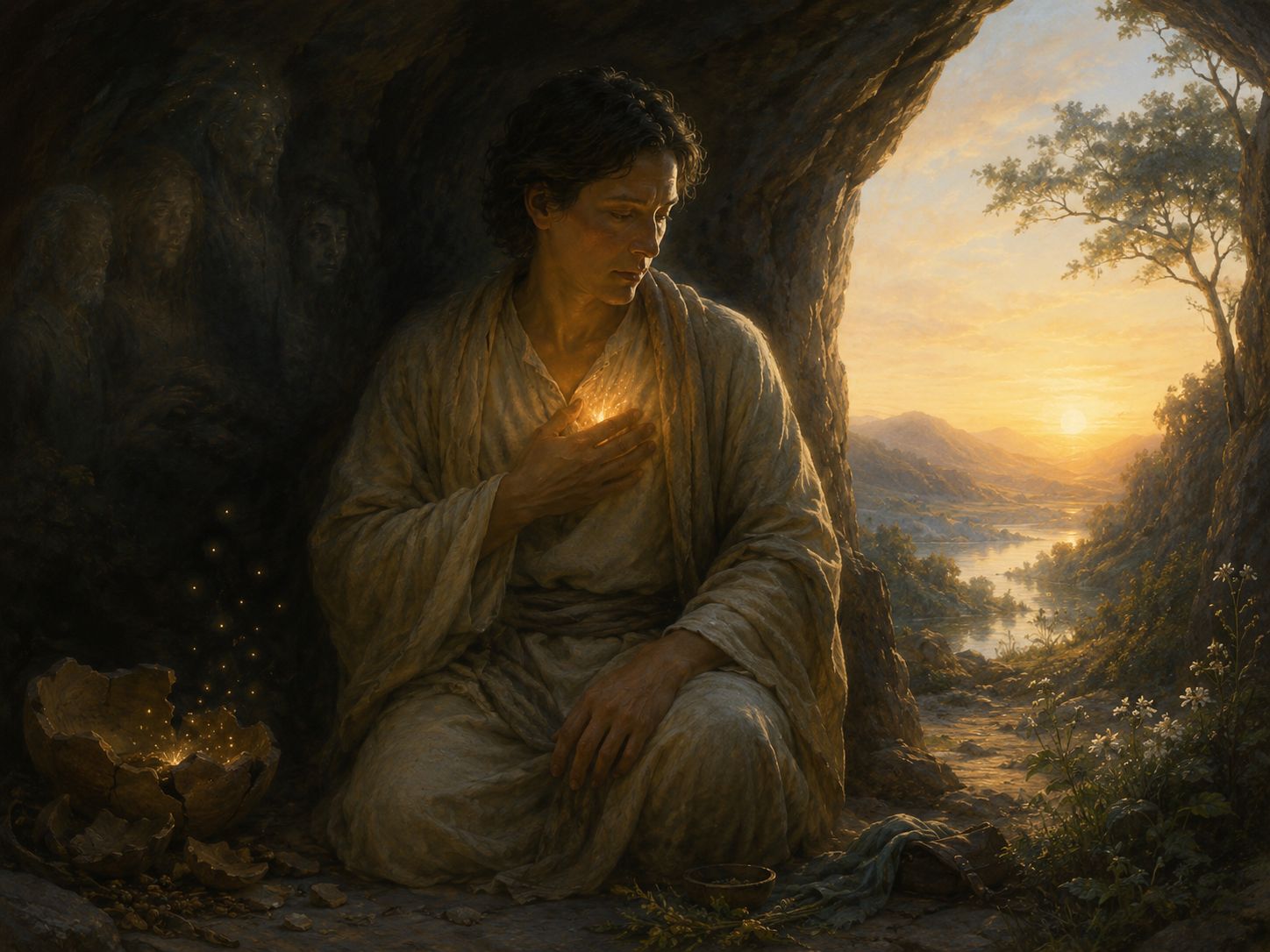
Kabbalah speaks of the same mystery in its own language. In sixteenth-century Safed, Isaac Luria described the beginning of creation as tzimtzum, God’s contraction into himself, through which he made room for the world. Into this emptied space he sent his light and prepared vessels that were meant to contain it and guide it downward through the levels of creation. But the force of the light was too great. The lower vessels could not bear it, and they shattered. This is called shevirat ha-kelim, the breaking of the vessels. Sparks of light, nitzotzot, fell into matter and became trapped in shells, klipot. Our world is the landscape after this shattering.
This is why repair has meaning. In an unbroken world, there would be nothing to mend. The sparks must be gathered and raised back to the source. Kabbalah calls this work tikkun.
The shell, the klipa, imprisons the spark and at the same time protects it. Without the shell, the light would be lost in the density of the world. This gives the wound a new meaning. The place where life has wounded us is the shell in which a spark waits to be released. For this reason, tikkun takes place precisely in the wound.
Hasidism drew from this a phrase that touches both the shaman and the wounded healer directly: yeridah tzorech aliyah, descent for the sake of ascent. The tzaddik, the righteous one, descends into lower and darker places in order to raise the sparks that have fallen there. Descent belongs to the path itself. Whoever wants to free the spark must first descend to the place where it fell. In this, the Hasidic tzaddik and the shaman walk the same road.
Lurianic Kabbalah therefore does not seek the sparks only in what is noble or elevated. It looks for them where they have fallen, even in what is low, broken, and dark. Tradition adds that the highest sparks fell the deepest, and that the most precious ones are therefore found in the lowest places. Alchemy expressed the same intuition in the image of the philosopher’s stone lying in the dung, in stercore, in the lowest place. Rabbi Nachman of Breslov summed it up in one sentence: if you believe in your ability to ruin, you must also believe in your ability to repair. The wounded healer is the one who first raises such a spark from his own darkness.
Healing Through the Wound in Homeopathy
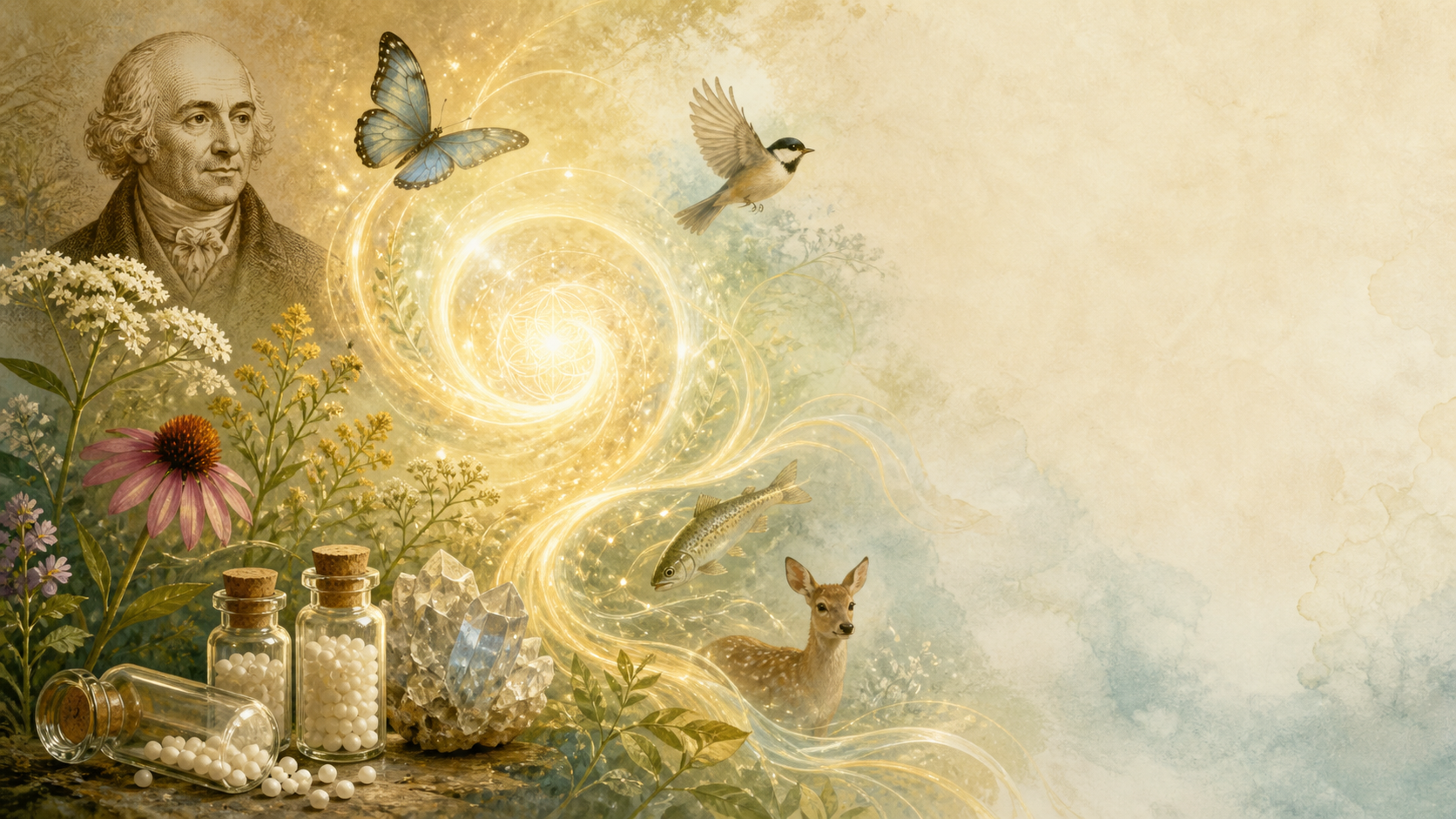
Homeopathy is built on the same pattern. We come to know the picture of a homeopathic remedy through provings. Healthy people voluntarily take a substance and allow its symptoms to unfold in themselves, so that they may discover what the substance can produce, and therefore what it can heal. The provers voluntarily enter the wound in order to bring back knowledge of the remedy. The wounded healer thus stands at the very foundation of homeopathy.
The law of similars says the same thing from the other side. The remedy for a particular state is the substance that can produce a similar state in a healthy person. The healing power is hidden in what can cause illness, and it becomes accessible through similarity. The similimum is the source — mineral, plant, or animal — whose signature corresponds to the state of the patient. When we find it, we are not adding something foreign to the person. We are giving his own blocked state a form to which he can respond.
Levy’s observation that the symptom is an attempt at healing is self-evident in homeopathy. A symptom is the best answer the organism has been able to find at that moment. We do not seek to suppress it. We seek to understand it and support the direction in which the vital force is already moving.
Whitmont, Sulphur, and Psora
Edward Whitmont, depth psychologist and homeopath, understood the story of Genesis in the same way. The expulsion from paradise is not a story of guilt. It describes the separation of individual consciousness from the whole, the first wound from which the human condition arises. Matter and the body remain good. This is the old Jewish and Pythagorean line, opposed to the Gnostic view that saw matter as a prison.
Buddhism places avidya, the delusion of the separate self, at the beginning of suffering. Psora corresponds to this very root: the delusion that I am separate. For Whitmont, Sulphur is the philosopher’s stone and at the same time the chief remedy of psora. In Sulphur, Whitmont brought together two levels. In homeopathy, it is the main remedy of psora, the remedy for the delusion of separation. In alchemy, sulphur is the principle of transformation, changing the coarse into the subtle. The same substance therefore heals the first wound and carries the power of transformation.
From psora arise two reactions. The sycotic miasm holds and accumulates. It wants more and more, grows through excess, and is always longing for something. The syphilitic miasm decomposes and destroys. It is the expression of aversion and hatred turned against others, and also against oneself.
The meaning for clinical work is direct. The patient’s individual symptoms often grow from a single root. When we recognize in his picture the primary delusion of separation, we find the experience from which the other symptoms arise.
Lanthanides
The lanthanides carry the theme of inner autonomy gained through confrontation with one’s own shadow and through taking responsibility for it. Their theme concerns one’s own darkness, the work a person must do alone within himself. It is the image of someone who has gone through the descent and returned with self-knowledge. A lanthanide person often does precisely this inner work, through which the wounded one becomes a healer.
Suffering is not enough
The gift of the wound is not healing in itself. Trauma does not become wisdom by itself. Most often, it repeats itself, and the person remains trapped inside it. Pain becomes healing only when we stop repeating it and consciously pass through it. The shaman who does not survive the descent does not become a shaman. Nothing justifies suffering. The value lies in the consciousness we bring back from pain. Suffering itself does not contain that consciousness.
This distinction protects us from romanticizing the wound, which would sound false in the mouth of a healer. A person who suffers does not need to be told that his wound is a gift. He needs a guide who knows the path because he has walked it himself.
The Homeopath as Wounded Healer
Here we return to what it means to be a healer. Only someone who has passed through separation and wounding can accompany another person on the path back to his true nature and source. Whoever has descended and returned knows the way from his own experience and can guide another along it. Our own work on ourselves is not secondary. It is a necessary condition.
A homeopath who has passed through his own darkness understands the symptom differently. He sees in it a signature, a form with a depth that reaches beyond its outward shape. The same capacity through which he understands his own wound opens the wound of another person to him. That is why the descent we have passed through becomes the source of our work with others.