

Philip K. Dick is one of those writers for whom it is sometimes difficult to draw a clear line between literature, philosophy, mysticism, and a personal struggle to understand the world. He is best known as a science-fiction author. His works inspired films such as Blade Runner, Total Recall, Minority Report, A Scanner Darkly, and the series The Man in the High Castle. He did not write most of the screenplays himself; filmmakers adapted his novels and short stories. Yet behind his fantastic narratives there was, from the beginning, a question that followed him throughout his life: What if the world we take to be real is not what it seems?
In his earlier books, this question was a literary motif. After 1974, however, it became a personal problem. Dick became convinced that he himself had experienced something that could not easily be classified as an ordinary human experience. For the next eight years, he never stopped asking what had actually happened to him.
The result was roughly eight thousand pages of handwritten notes, which he called the Exegesis. After his death, a nearly thousand-page selection from them was published as The Exegesis of Philip K. Dick.
A World That Cannot Be Trusted
Dick was born in 1928 and wrote dozens of novels and more than a hundred short stories during his lifetime. Although he is usually classified as a science-fiction writer, his central themes are more philosophical than technological. What is a human being? What is consciousness? How do we know that our memories are true? How can we distinguish a human being from a perfect imitation of one? What if reality has several layers? And above all: how do we know that the world we are experiencing is real?
For Dick, reality is not a fixed backdrop against which the story unfolds. Reality itself is suspect.
His stories are filled with false memories, uncertain identities, altered political histories, deceptive bodies, and unstable worlds. His characters often find themselves in situations where another layer appears beneath the surface of familiar reality, and once that layer is uncovered, yet another lies beneath it.
What had initially been a literary device acquired an entirely new meaning for Dick in 1974.
February and March 1974
Dick referred to the series of events that took place in February and March 1974 simply as 2-3-74. After dental treatment, a young woman brought him pain medication. She was wearing a fish-shaped pendant, an early Christian symbol. Light reflected from the pendant triggered a strange shift in his state of consciousness.
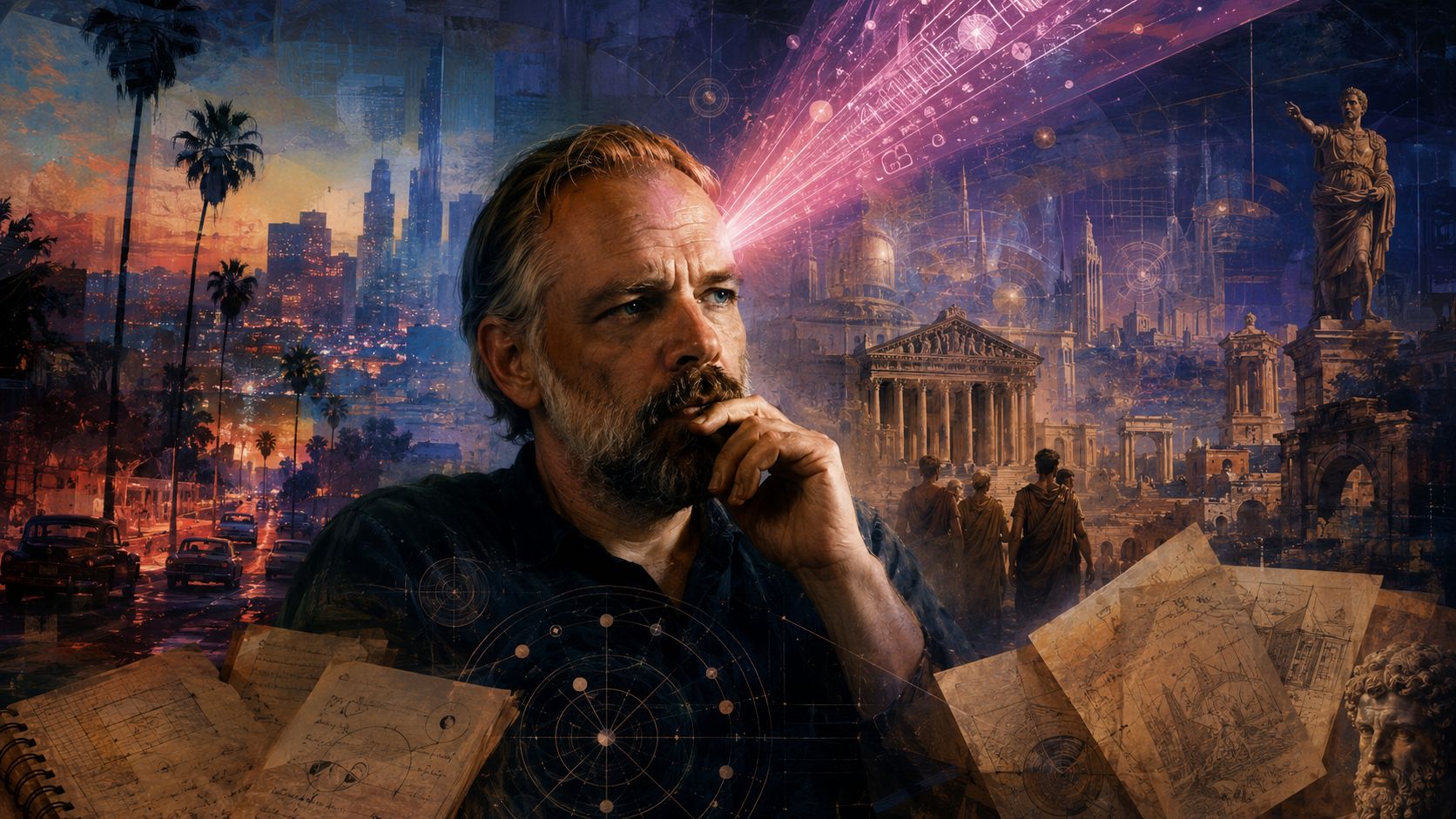
What followed was a series of visions, dreams, and unusual states that continued for several weeks. Dick described geometric patterns, intense dreams, a sense of the presence of an alien intelligence, and above all a pink beam of light that seemed to transmit information directly into his mind.
At times he felt that contemporary California had disappeared and that ancient Rome had emerged behind it. He became convinced that, in some sense, the Roman Empire had never ended. He later expressed this idea in the famous sentence: “The Empire never ended.”
For him, however, the “Empire” gradually came to mean more than a historical or political entity. It became a structure of reality that keeps human beings trapped in ignorance, fear, and a false image of the world.
From this emerged the idea of the Black Iron Prison. What we consider the normal world may be a prison created by our inability to see its true nature. The resemblance to Gnosticism is clear.
A person lives in a world they take to be the whole universe, yet has forgotten where they come from. Liberation then comes through gnosis, direct knowledge, rather than through the acceptance of a particular doctrine.
Who or What Had Contacted Him?
Instead of immediately declaring, “It was God,” Dick began constructing hypotheses. He continued doing so until his death. It might have been psychosis, a neurological phenomenon, telepathy, God, Christ, the Logos, a future version of his own consciousness, an extraterrestrial intelligence, a satellite transmitting information, the collective mind of humanity, or some informational structure built into the universe itself. Perhaps several of these possibilities were true at once.
This is precisely what makes the Exegesis such an extraordinary book. We are not reading a finished metaphysical doctrine. We are watching a human mind thinking in real time, trying to construct a model capable of explaining its own experience. Whenever Dick believes he has found the answer, a few pages later he begins to question it again. In this respect, the Exegesis may be more interesting than many systematic works of philosophy. We can watch metaphysics being created before our eyes.
Zebra and VALIS
One of the names Dick used for the intelligence hidden behind the world was Zebra. Why Zebra? Because, in his view, this intelligence was perfectly camouflaged by its environment. It was present everywhere, yet people failed to see it precisely because it blended into the world. Later he adopted a much better-known name: VALIS – Vast Active Living Intelligence System.
Dick did not imagine God primarily as a distant being standing outside the universe. He moved increasingly towards the idea of an intelligence operating through the very structure of reality. In the Exegesis, he used several names for this presence: Zebra, God, VALIS.
He gradually ceased to regard matter as the most fundamental level of reality. Information became increasingly important. What he believed had happened to him was not simply a vision of an image or a figure. He felt that information had entered him. And this information was not inert. It was intelligent. It organised, knew, communicated, and acted.
A Living Informational Universe
Let us consider two possibilities. In the first, there is a material universe. Somewhere within it, through evolution, a brain appears, and consciousness arises in the brain. Information is then something created and processed by living organisms.
Dick explored the reverse possibility. What if information is more fundamental than matter? What if what we call the physical world is the outward expression of an informational structure? And what if this informational structure is not blind, but possesses properties of mind?
This opens a very different picture of reality. The universe no longer resembles a machine, but a living informational process.
God need not be a person situated somewhere outside the world. The divine may manifest itself as informational intelligence operating from within reality itself. VALIS sometimes resembles a cosmic computer, at other times the Logos, Christ, or a living universe gradually awakening to consciousness. Dick never finally chose between these images.
Time Is Not What It Seems
Dick thought about time in equally radical ways. If, during his visions, he saw 1970s California and ancient Rome at the same time, what did that mean? The simplest answer is hallucination. But he explored another possibility. What if the past never completely disappears? What if history is not merely a linear succession of events, but different layers of time in some sense exist simultaneously? What if ordinary consciousness perceives only a very narrow slice of a much larger temporal structure?
Such reflections led him to strange models in which the first Christian century overlaps with the twentieth, and in which the history we regard as past may itself be, to some extent, a projection.
It would be a mistake to turn Dick into a systematic philosopher of time. He was not one. His strength lay elsewhere. He allowed himself to ask questions in places where most people no longer see anything to question.
What Makes a Human Being Human?
From this perspective, we can also better understand the novel Do Androids Dream of Electric Sheep?, which became the basis for Blade Runner. On the surface, it asks whether a human being can be distinguished from an android. Beneath this lies a much deeper problem: What makes a human being human? Biology, memory, empathy, consciousness, the capacity to suffer, our relationship to others?
If a perfect copy of memories can be created, how do I know that my own memories are genuine?
If my conviction about who I am depends on memory, what remains of my identity when I discover that memory can be manipulated?
These questions later appeared in adaptations of Dick’s work such as Blade Runner and Total Recall.
His novels therefore deal less with robots, implants, or future technologies than with ontological uncertainty: uncertainty about what is real. After 1974, this uncertainty became part of Dick’s own life.
When His Own Life Entered the Novel
After the events of 2-3-74, Dick could no longer write in quite the same way. His personal experiences began to enter directly into his fiction. One of the first attempts was Radio Free Albemuth, written in 1976 and published only after his death. It was his first extensive attempt to transform the experiences of 1974 into fiction. The novel even includes a character named Philip K. Dick. Reality and fiction begin to overlap.
There is the writer Philip K. Dick, who believed he had experienced contact with an unknown intelligence. And there is a fictional Philip K. Dick living in a world where a mysterious intelligence communicates with people through signals. Where does autobiography end and science fiction begin? Dick seems deliberately to blur the boundary.
He later reworked the same material in VALIS. In the Exegesis and in his later novels, personal metaphysical experience, theology, and fiction increasingly begin to illuminate one another. Other works connected with his visions include The Divine Invasion, The Transmigration of Timothy Archer, and Radio Free Albemuth.
Horselover Fat
In VALIS, Dick split himself into two characters. One is Philip K. Dick. The other is Horselover Fat. The name is a linguistic joke: Philip derives from a Greek name associated with a “lover of horses,” while the German word dick means “fat.” Horselover Fat is therefore, in a sense, a translation of his own name.
This device allows Dick to conduct a dialogue with himself. One part of his personality experiences revelation. The other observes it. One believes. The other doubts. One constructs a metaphysical system. The other asks whether the first is losing his mind.
It is a remarkably accurate literary image of what Dick was doing for years in the Exegesis. He was simultaneously a mystic and his own sceptical observer.
Christopher Bache: A Similar Journey, a Different Outcome
It is interesting to compare Philip K. Dick with Christopher M. Bache. Bache is a professor of philosophy and religious studies who, over a period of twenty years, underwent 73 high-dose LSD sessions, systematically recording and analysing his experiences. The result was the book LSD and the Mind of the Universe, which was also published in Czech in 2024 as LSD a mysl vesmíru by Diamanty z nebes.
At first glance, their stories are very different. Dick’s experiences came spontaneously and caught him unprepared. Bache entered altered states of consciousness deliberately and repeatedly. Dick spent eight years trying to understand one immense eruption of experience.
Bache returned to these states repeatedly over two decades and was able to compare individual sessions. This difference profoundly shaped the outcome.
Dick’s Exegesis branches in many directions. Bache’s map gradually becomes more unified.
What Bache Discovered
Bache moves gradually from personal psychological material through transpersonal layers towards experiences of what he interprets as a unified field of consciousness underlying physical existence. According to his interpretation, beyond the deepest levels of individual consciousness lies a unity with the qualities of consciousness and creative intelligence.
At this point Bache and Dick come surprisingly close. Dick speaks of VALIS, a living intelligent system. Bache describes the Mind of the Universe.
After extraordinary experiences, both arrive at the possibility that consciousness or intelligence may not be merely a local by-product of the human brain, but may belong to the very structure of reality itself.
Where They Differ
Despite these similarities, there is an important difference between them. Dick never really knew what exactly he had discovered. His strength lies in the questions he kept asking. Bache gradually acquired much greater confidence in the map he developed from his experiences. His question might be expressed as follows: What layers of reality become accessible when human consciousness is radically altered?
Dick’s question is different: What is actually happening to me, and how much of it can I regard as real?
For this reason, Bache’s book is more orderly. Dick’s Exegesis feels like an intellectual storm. Reading it is like entering a laboratory in which the experiment is being conducted, the results are being analysed, and the laboratory apparatus itself is being rebuilt at the same time.
Mysticism or Illness?
In Dick’s case, an uncomfortable question cannot be avoided. Was he simply mentally ill? His life included drug use, psychological crises, paranoia, and periods of considerable instability. His experiences can therefore be interpreted neurologically or psychiatrically. Dick himself repeatedly considered this possibility.
This is one of the reasons his story remains intellectually compelling. If he had simply declared with complete certainty that he was communicating with God, the Exegesis would be far less interesting. Instead, he continually moved between possibilities: perhaps it was God, perhaps the brain, perhaps both.
If a mystical experience has a neurological correlate, does that prove that its content is false? Every ordinary experience also has a neurological correlate. When we see a tree, the brain becomes active. That does not mean the tree does not exist. Identifying a brain mechanism therefore does not by itself decide whether an experience refers only to an internal state of the brain or also to something beyond it.
Here Dick once again meets Bache. Both force the reader to confront an epistemologically difficult question: By what criterion do we decide which states of consciousness tell us something about reality and which are merely illusions?
Dick’s Greatest Discovery
Dick ultimately did not create a philosophical system that could be reduced to a few propositions. Yet a certain intuition emerges from his thousands of pages. Reality may be layered. What we call the material world may not be its final level. Beneath the surface there may be an informational order. Information may be active. Active information may possess qualities of intelligence. Individual consciousness may not be entirely separate from this deeper intelligence. And under certain circumstances, a person may briefly experience a disruption of the boundary between these layers.
Whether Dick was right, we do not know. He did not know either. That is part of what makes his story so compelling.
The Writer Caught Up by His Own Theme
Perhaps the most striking thing about Philip K. Dick is that for decades he wrote stories about people who gradually discover that reality is different from what they had believed. Then something remarkably similar happened to him. The writer found himself inside his own theme. From that point onward, his science fiction, personal life, philosophy, and mystical experience became so closely intertwined that they are sometimes impossible to separate.
Dick does not tell us: This is the true nature of the world. His question is: How can we be sure that the world is the way we think it is?
After decades of exploration, Christopher Bache arrived at an image of a universe permeated by consciousness. Dick reached a similar possibility by a much more chaotic, contradictory route and with far more doubt. Bache brought back a map of the territory. Dick shows us a man who woke up one day in an unfamiliar landscape and spent the next eight years trying desperately to understand where he was.
That is why The Exegesis of Philip K. Dick may be even more fascinating than his novels. It is the record of a man who reached the limits of his worldview and refused to pretend that he knew what lay beyond them.

