
The Last Emperor’s Garden: On Bringing Spirit into Matter
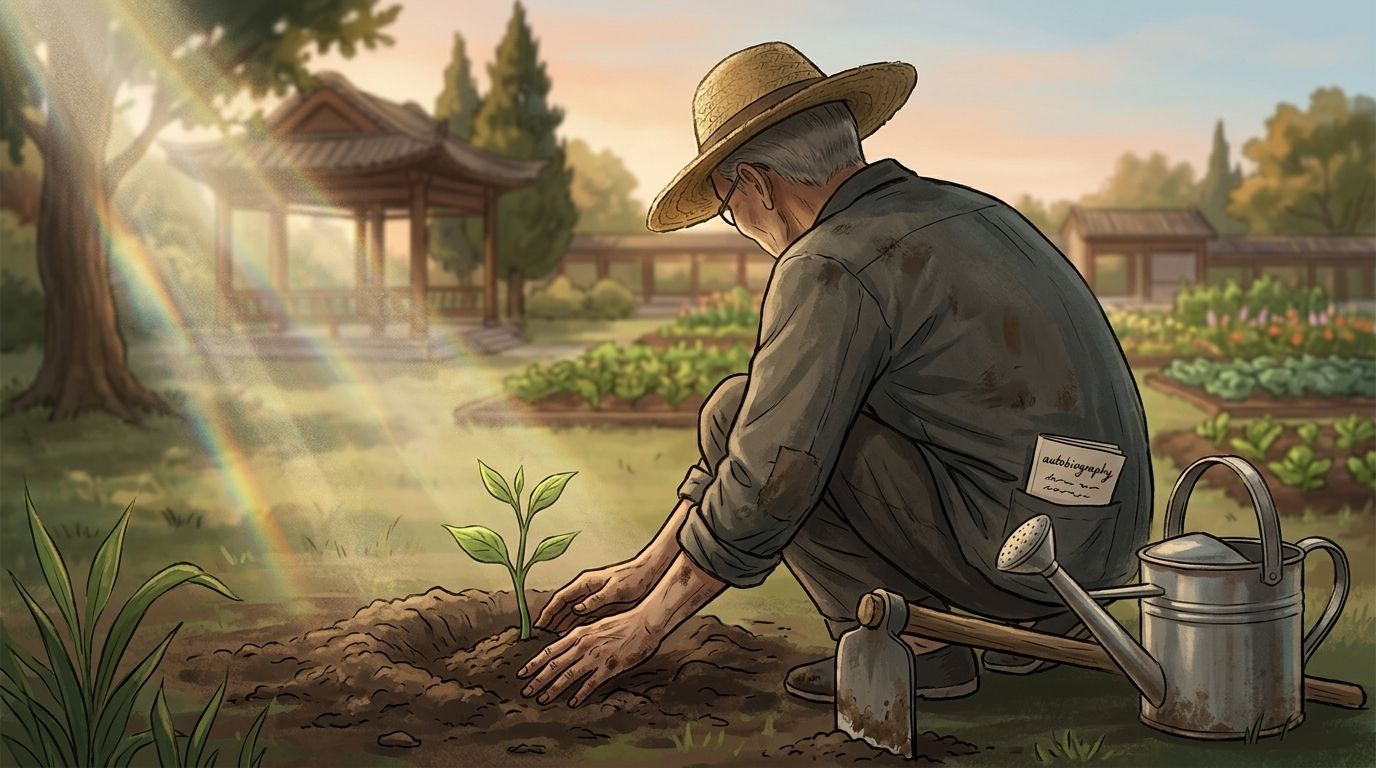
The French sent their king to the guillotine. The Bolsheviks shot the Romanovs in a cellar in Yekaterinburg. China’s last emperor, Puyi, survived the fall of his empire and a decade of imprisonment, and spent his final years working as an assistant gardener at the Beijing Botanical Garden.
He ascended the throne in 1908 at the age of two. In 1912 the Xinhai Revolution ended the rule of the Qing dynasty. The young republic lacked the strength to hold the country together and wished to avoid civil war, so it negotiated a settlement with the court. The boy abdicated, yet he kept his title, continued to live in the Forbidden City and received a state allowance. In 1924 the warlord Feng Yuxiang drove him out of the palace. Puyi turned to the Japanese, who installed him as the puppet ruler of Manchukuo. In 1945 the Soviet army captured him, and in 1950 handed him over to the new People’s Republic of China.
His collaboration with the Japanese occupiers would have justified a death sentence. Mao Zedong and the Party leadership chose otherwise. An executed emperor would become a martyr to those who still revered him. A reformed emperor would demonstrate the power of the new order. Puyi spent nearly ten years at the Fushun War Criminals Management Centre. At first, relatives and former servants imprisoned alongside him continued to wait on him, until the authorities separated them. A man who had been dressed, fed and bathed by others all his life learned, for the first time, to tie his own shoes and wash his own clothes. He was pardoned in 1959. He worked in the botanical garden, later in an archive of historical documents, and wrote an autobiography describing his passage from emperor to citizen. He died in 1967.
What his hands did
The regime set out to strip the throne of its sacred aura, and it succeeded. An emperor hoeing flower beds commands no one’s reverence. Politically, this was a calculated strategy of humiliation.
We cannot see into Puyi’s mind. We can, however, see what his hands did. A man kept from childhood at a distance from his own body and from the earth touched the soil in middle age. He dressed himself, cleaned up after himself and tended living plants. He lived in the material world without intermediaries. The Forbidden City had shielded him from reality; prison and the garden returned him to it.
His story allows two readings. For the regime, it proved its power. For us, it can serve as an image of something happening to humanity as a whole.
Light entering matter
Christopher Bache, an American philosopher and scholar of religion, spent two decades exploring deep states of consciousness and recorded his experiences in LSD and the Mind of the Universe: Diamonds from Heaven. He describes a transformation of humanity, the birth of what he calls the Future Human, a new kind of soul of diamond-like clarity. In his account, this transformation moves toward the world. Our task is to bring divine light into matter, into the body and into everyday life.
Many religious and spiritual paths teach us to turn away from matter. They regard the body as a prison and the world as a place of temptation. Spiritual life then becomes an ascent and a departure. Bache describes the opposite direction: spirit descends and transforms whatever it touches.
Christianity holds this insight at its foundation. The Word became flesh. God entered a human body, the trade of a carpenter, the dust of the roads. The Benedictines expressed the same understanding in the rule ora et labora. In the monastery, prayer and manual work form a single whole. The monk tending vegetables prays as truly as the monk in the choir.
Little emperors
Many of us now live like little emperors in our own Forbidden Cities. Couriers bring our food, people on the other side of the world sew our clothes, machines keep our homes in order. Our hands touch mostly screens. We do not know where our bread comes from, and we cannot repair the things we use every day. Comfort separates us from the world much as the court once separated Puyi.
In such a life, the spiritual search easily turns into a form of escape. We seek higher states, distant realms, an enlightenment somewhere beyond the body. Bache’s experience and the Christian tradition both lead us back. Light needs a place to enter, and that place is our body, our work and the ground beneath our feet.
When we bake bread, plant a tree or mend a chair, we join consciousness to matter. The attention we bring to the task changes the act itself. For Puyi, manual work was a punishment imposed by the state. We can choose it freely and put into it the best of what we are.
Puyi lost his throne, his palace and his sanctity. He gained a garden. We cannot know whether he experienced it that way. His story reminds us that the way back to the earth is always open, and that this return belongs to the spiritual path.