
In today’s Western world, there is a growing sense of chaos. Society appears increasingly fragmented, shared values are eroding, and people struggle to find common ground even on the most ordinary questions of life. In a video that caught my attention, Dr. Zac Porcu offers an explanation for how we arrived at this point.
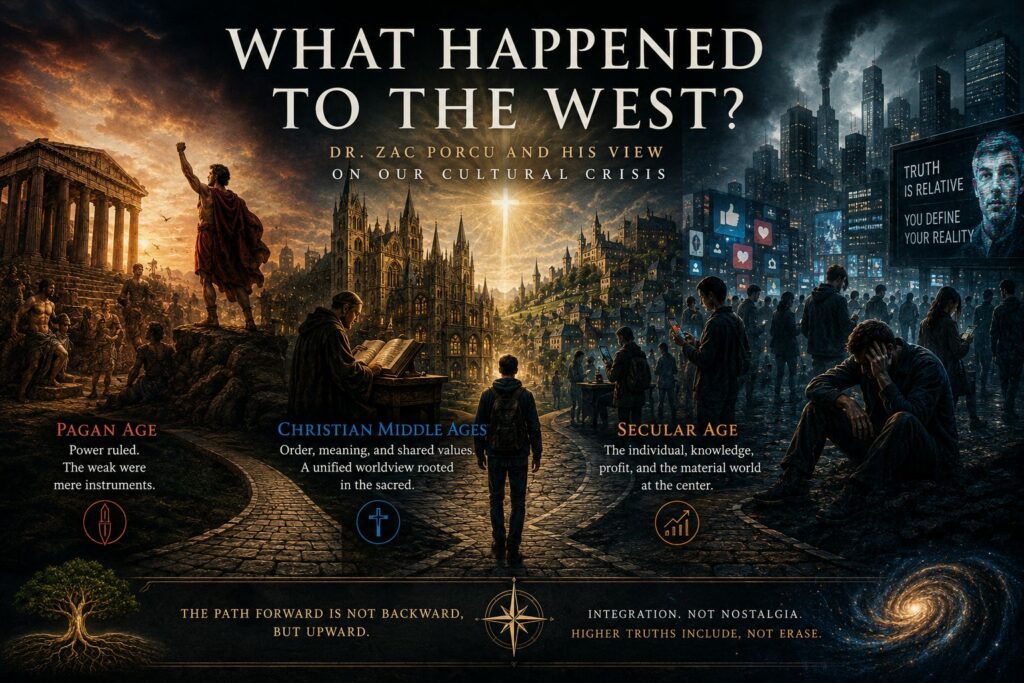
Porcu begins with a brief overview of Western history. He divides it into three major eras: the pagan culture of antiquity, the Christian Middle Ages, and the modern secular age. According to him, two great revolutions shaped the course of Western civilization.
The first came with Christianity, which transformed the world through the radical claim that God became human, conquered death, and invited human beings to participate in His life. Human beings were no longer viewed merely as tools or possessions. Every person acquired inherent value because each person was understood as bearing the image of God.
In Porcu’s interpretation, the Middle Ages were not an age of darkness. They represented a period in which culture rested upon a shared framework of meaning. Church and society were not separated because questions of truth, humanity, and reality were understood as inseparable. Universities, scientific inquiry, systematic learning, and even the idea that the world is orderly and intelligible emerged within the context of Christian civilization.
The second revolution began with scholasticism, which, in Porcu’s view, laid the groundwork for the Renaissance and the Reformation. He describes this as a decisive historical turning point. Christianity, he argues, underwent what he calls an “Islamization.” Instead of deriving faith primarily from the person of Jesus Christ, religion increasingly became grounded in Scripture itself. Unlike Islam, however, Christianity was never intended to be founded solely upon a text. Texts can be interpreted in many different ways. As a result, the previous unity of faith gradually dissolved. Christianity fragmented into hundreds of competing interpretations, and religion shifted from a shared cultural reality into the realm of personal opinion. This development opened the door to modern secularism, which progressively pushed the sacred to the margins and replaced the communal with the individual.
According to Porcu, secularism is built upon the assumption that society can function without reference to anything sacred. It assumes the existence of a neutral space governed solely by facts and scientific data. Yet this model remains incomplete. Scientific knowledge does not answer questions about meaning, goodness, beauty, values, or the purpose of life. It cannot explain why human beings possess intrinsic worth in the first place.
Modern society continues to affirm human dignity and the value of human life, yet it lacks a coherent foundation for doing so. One group argues for the protection of life, while another views humanity as a burden upon the planet. Despite its faith in progress and humanism, the twentieth century witnessed the greatest mass killings in history, enabled by scientific and technological advancement. Modernity’s trust in reason, progress, and technology culminated in world wars, gulags, gas chambers, and nuclear weapons. The hope for a rationally managed world faded, and the shared moral framework that once united society began to disappear.
Porcu argues that without roots in something deeper, society has entered a condition in which no common culture remains. Family, education, and politics all struggle to find a shared foundation. Secularism presents itself as neutral, yet it is itself another metaphysical position lacking a secure grounding. In other lectures, Porcu also warns about the dangers of ideological systems. Every ideology tends to create the conviction that it possesses ultimate truth and that its opponents are simply mistaken. The result is division rather than a genuinely shared vision.
His message is not merely critical. Porcu also speaks about how to live within a secular age without being consumed by it. Christianity, he says, does not exist in order to wage war against modernity. Its purpose is to point toward a good life. The challenge is to live from something more enduring than the shifting moods of the age. The goal is not hatred of evil, but love of the good.
Although politics surrounds us, Porcu insists that it should not become the center of life. In earlier times, politics emerged as a consequence of deeper moral and spiritual convictions. Today, for many people, politics has become a substitute religion. Individuals derive identity, purpose, and belonging from political affiliations. Porcu warns that when people stare too deeply into the emptiness of secularism, they begin to fragment internally. The remedy, he believes, lies in returning to questions that transcend politics and address the deeper identity of the human person.
Without a stable foundation, neither society, nor family, nor individual life can flourish. Sooner or later, anyone who sincerely seeks to understand the world is drawn back to this realization.
Viewed through the lens of Spiral Dynamics, the three cultural periods Porcu describes can be associated with different value systems. The pagan age corresponds largely to the Red meme, where power determined status and the weak existed primarily as instruments. The medieval world reflects the Blue meme, characterized by order, hierarchy, shared values, and a spiritual vision of reality. The secular age, stretching from the Renaissance to the present, reflects the Orange meme, which places the individual, knowledge, achievement, and material progress at the center of life.
Porcu sees the solution in returning to the spiritual tradition that existed before the year 1050, when faith was embraced without attempting to subordinate it to philosophical systems. I see the matter differently. From the perspective of developmental evolution, the path forward does not lead backward. It leads upward. Higher memes do not erase the value of earlier ones. They transcend and integrate them. The challenge is not nostalgia for a lost world but the recognition that different layers of reality can coexist in harmony.
Contemporary science, philosophy, neuroscience, and consciousness research are gradually leading us toward insights that ancient traditions expressed in their own symbolic languages. Beneath the surface of matter lie dimensions that exceed ordinary sensory perception: energetic layers, informational layers, layers of consciousness, and beyond them something that cannot be fully captured by concepts. The Kabbalists called it Ain Sof—the boundless, the limitless, the unknowable that nevertheless encompasses everything. This is not a replacement for modern science. It is a reminder that reality may be more layered than we commonly assume.
If a cultural transformation is to occur, it will not be a return to the past. It will be a new integration. We need a framework that gives space both to knowledge and to spiritual experience. We need a language that is modern while remaining open to deeper dimensions of reality. And we need a worldview capable of bringing scientific understanding into dialogue with the human need for meaning and purpose.
Perhaps this is the next step in the evolution of Western civilization. Not a return to the Middle Ages, but the ability to recognize that beneath the surface of our rationally organized world lies a deeper order—one that spoke to humanity in earlier ages and that we are now rediscovering through different means. If these dimensions can be brought together, a culture may emerge that stands firmly without becoming rigid, that values the individual without losing contact with what transcends us all.
Such a culture could reopen a genuine dialogue about human beings, society, and reality itself. It would begin from the recognition that the world is richer than it first appears. And that recognition may provide the foundation that our fragmented culture is searching for today.
Incredible Speech on Western Civilization, Christianity, & Secularism – Dr. Zac Porcu
https://www.youtube.com/watch?v=6s64qQ4dEMg