
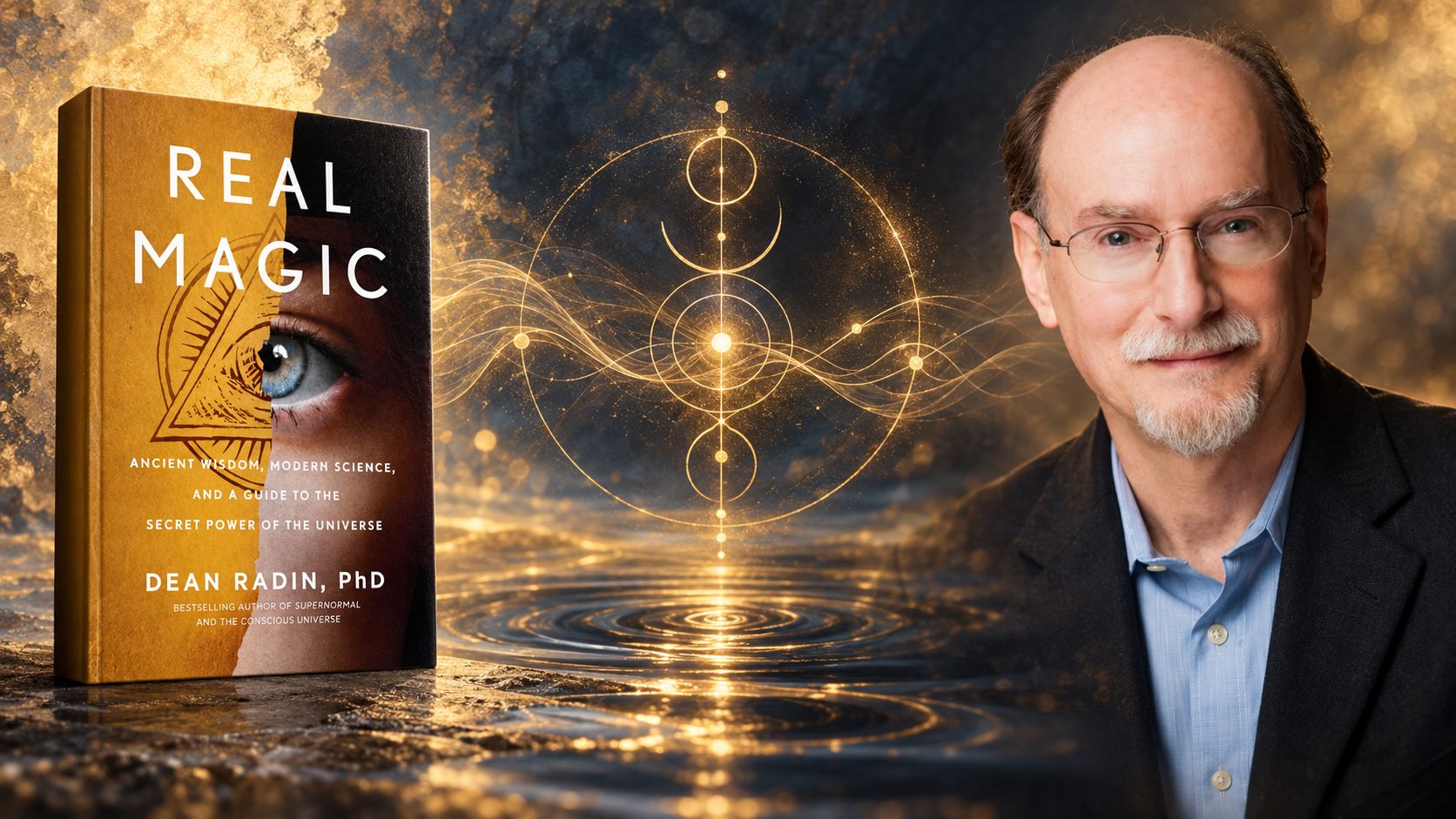
Dean Radin and his book Real Magic
Dean Radin is among the best-known consciousness researchers of our time. He studied electrical engineering, physics and psychology, worked on cybernetics and artificial intelligence at the University of Illinois, and has spent most of his professional life in laboratories investigating the relationship between mind and matter. For many years, he has served as Chief Scientist at the Institute of Noetic Sciences in California. The Parapsychological Association, an affiliated organisation of the American Association for the Advancement of Science (AAAS), has elected him president five times.
In 2018, he published Real Magic: Ancient Wisdom, Modern Science, and a Guide to the Secret Power of the Universe. The title is deliberately provocative. In the introduction, Radin writes that he has been studying magic using scientific methods for some forty years. For the first thirty-nine of those years, he would have firmly rejected such a description. He understood his work as parapsychology, the serious investigation of psi phenomena, and associated magic with fairy tales and stage tricks. Only while writing this book did he realise that telepathy, clairvoyance, precognition and psychokinesis, which he had been measuring in the laboratory throughout his career, were the very phenomena that ancient traditions called magic. Both fields describe the same phenomena associated with consciousness. Both stand on the margins of academic science, and orthodox religions regard both as dangerous.
Radin divides real magic into three categories. The first he calls force of will; it encompasses every attempt to influence events mentally, from a spell to a prayer. The second is divination, the perception of events distant in space or time. The third is theurgy, communication with non-physical beings. This article focuses on the first category and on a question of particular importance to physicians and homeopaths: can a symbol have an effect? Can meaning, impressed upon a sign, water or a substance, alter a person’s condition? And if so, what does this tell us about the nature of reality?
The Symbol as Part of the Structure of the World
Radin begins with language. The verb ‘to spell’ means arranging letters into words and words into sentences. As a noun, a ‘spell’ is a magical incantation. The two meanings are connected: a spell also assembles symbols into larger configurations that refer to things, events and concepts. The difference lies in the underlying worldview. A spell presupposes a world in which everything is connected beyond the boundaries of space and time. The Hermetic tradition calls this the law of correspondences: as above, so below; as within, so without.
The verb ‘to draw’ works in a similar way. It means both to make a picture and to attract. According to magical tradition, someone drawing a symbol draws its meaning into existence. Radin explains this with a simple example. If the word Fido corresponds to an actual dog named Fido, then an operation performed on the symbol will also affect the dog itself. In his view, this principle underlies lucky charms, voodoo dolls and homeopathy alike. We shall return to the last point, because from a homeopathic perspective this comparison needs to be clarified.
From the perspective of magic, a symbol points to a relationship while also forming part of the structure of reality. Radin looks to physics for support for this idea. The Princeton physicist John Wheeler formulated the thesis ‘it from bit’: every thing, every particle, every field of force, even the space-time continuum itself, derives its function, its meaning and its existence from answers to yes-or-no questions — from information. Max Tegmark of MIT went further. In his view, physical reality is a mathematical structure, a set of abstract relationships. If so, whoever changes abstract relationships also changes the physical world. Radin adds a sentence that forms the central thread of the chapter: this is precisely the idea behind a sigil.
The magician Patrick Dunn, a specialist in semiotics, puts it even more directly. If reality is symbolic in nature at a level deeper than the quantum level, then manipulating symbolic systems changes the semiotic network and thereby changes reality.
What a Sigil Is
The word sigil comes from the Latin sigillum, meaning a seal. Radin defines it simply: a sigil is a symbol of a desired goal. The modern form of the technique was developed by the British painter and occultist Austin Osman Spare (1886–1956). His work became the basis for what is known as chaos magic, developed by Peter Carroll in the 1980s.
Radin explains why a sigil works better than an ordinary written wish. Creating a sigil requires more focused attention than writing a sentence. An abstract sign also weakens the influence of the analytical mind, which would otherwise keep commenting on the goal, doubting it and monitoring it. The magician first ‘charges’ the sigil and then ‘releases’ it. Charging focuses emotion, intention and belief on the goal. Releasing transfers the goal from the conscious mind to the unconscious.
The procedure Radin describes has six steps:
- Write the wish as a sentence, for example, ‘I find a ten-dollar bill’.
- Take the initial letters of the words, omitting words that begin with a vowel. In this example, the letters FTDB remain.
- Combine the letters into a single abstract sign in which the original words are no longer recognisable.
- Charge the sign. Focus on it and project either deep calm or a powerful emotion into it. Magicians use deep meditation, intense concentration, physical exertion, anger or the peak of sexual arousal for this purpose.
- After charging it, put the sigil aside. Some burn it; others glance at it occasionally or place it somewhere they will see it from time to time. The intention is meant to pass from consciousness into the deep unconscious and work there.
- Maintain belief and keep silent. Keep the meaning of the sigil to yourself and use it only for good purposes.
There is a practical reason for secrecy. Other people may introduce doubt into our intention, and doubt weakens the effect. Radin also repeatedly stresses an ethical boundary. He regards influencing another person without their consent as morally questionable, even when we wish them well. He compares magic intended to harm others to Newton’s third law: in a world where everything is connected, a harmful intention returns to the person who sent it.
Does It Work?
Radin’s answer, based on his experience both in life and in the laboratory, is yes. Not always, and not spectacularly, but often enough to deserve our attention. In everyday life, the outcome usually appears as a meaningful synchronicity; in the laboratory, as a statistically significant test result. In both cases, what matters is focused intention, openness to the idea that the goal has already been achieved, and a clearly formulated goal.
As an example, he tells a story from early 2000. Together with his colleague Richard Shoup, he was setting up the Boundary Institute, a research institute in Silicon Valley. A month before moving, he drew his ideal laboratory on the whiteboard in his office: a chair for experimental participants, a shielded chamber and other equipment he could not afford. After moving into an office in Los Altos, he noticed a sign on the neighbouring door: PsiQuest Research Labs. When he entered, the man behind the desk looked up in astonishment and spoke his name. The company’s president, Jon K., was practising Tibetan dream yoga at the time and had repeatedly wished for a sign that his venture was on the right track. One such sign was to be Dean Radin himself, whom he wanted to recruit to his board but did not know where to find. Looking around the neighbouring premises, Radin found the chair, shielded chamber and instruments he had drawn on the whiteboard. They stood less than two metres from his desk, on the other side of the wall. Radin comments: ‘I drew what I wanted into existence.’ He is playing on both meanings of the verb ‘to draw’.
Radin recognises that such a story proves nothing. Coincidences happen. He therefore takes the question into the laboratory.
Blessed Chocolate, Water and Tea
A sigil is concentrated intention impressed upon a sign. A blessing is concentrated intention impressed upon food or drink. Radin notes that the blessing of water, wine and bread occupies a central place in many religious ceremonies, and that toasting is found in every culture. The conventional explanation is that any healing following the drinking of blessed water is due to the placebo effect. Radin decided to test another possibility.
In 2006, he and his colleagues conducted a double-blind experiment with dark chocolate. They formulated the intention in a single sentence: ‘The person who eats this chocolate will show optimal health and functioning on the physical, emotional and mental levels, and will experience greater energy, strength and well-being.’ One batch of chocolate was blessed by two senior Buddhist monks, another by a shaman from Mongolia, and a third by an electronic device into which six experienced meditators had ‘imprinted’ the intention. The control group received identical chocolate from the same source, without a blessing. Sixty-two people completed the experiment. By the third day of eating the chocolate, mood had improved more in the groups receiving blessed chocolate than in the control group (p = 0.04). A stronger effect emerged among people whose usual chocolate consumption was below the average of 3.2 ounces a week (p = 0.0001). The improvement consisted mainly of reduced fatigue and greater vitality. The study was published in Explore in 2007.
Subjective assessments of mood are, however, a less reliable measure. Radin therefore worked with Professor Yung-Jong Shiah of Taiwan on an experiment involving Arabidopsis thaliana, commonly known as thale cress. This small annual weed belongs to the cabbage family and also grows in fields and along roadsides in Slovakia. Botanists and geneticists use it as a principal model plant, much as zoologists use mice or fruit flies. It grows quickly, and in 2000 its genome became the first plant genome to be sequenced. Arabidopsis contains cryptochrome, a protein sensitive to light and weak magnetic fields. Humans also have cryptochrome, and several studies ascribe quantum properties to it. Shiah hypothesised that a plant with such a protein might respond more sensitively to intention than other systems.
The monk Lu Cheng and two other monks from the Buddhist Bliss and Wisdom Foundation mentally blessed half of a set of twenty-four bottles of water for twenty minutes. Their intention was: ‘The Arabidopsis that receives this water will show optimal growth; in particular, it will have enhanced nourishment, energy, strength and well-being.’ To avoid affecting the control bottles in the same room, they added: ‘This enhancement applies only to this batch of water.’ Watering, germination and measurement were carried out by people who did not know which water had been blessed. The researchers used three types of seed: the wild type, a mutant with reduced sensitivity to blue light, and a mutant with increased sensitivity. Seedlings watered with blessed water had shorter stems (hypocotyls), indicating more robust growth, and more anthocyanins and chlorophyll. The effect was most pronounced in seeds with increased sensitivity to light. The experiment was repeated four times under different combinations of light, and the combined stem-length measurements corresponded to a chance probability of one in 38 trillion. The paper appeared in Explore in 2017.
The third experiment concerned belief. The Taiwanese team gave 221 participants bottles of oolong tea, half of which had again been blessed by monks. At the end of the week, each participant was asked whether they thought they had been drinking blessed tea. Among those who believed they were drinking blessed tea, mood was better in those who actually had received it. The difference was modest. Among those who did not believe they had received blessed tea, no difference emerged. The strongest result came from a third set of comparisons: everyone had drunk the same blessed tea, but some believed they had received it and others did not. The improvement in mood among the believers corresponded to a chance probability of one in 50,000. Radin concludes that the blessing has an effect and that belief markedly amplifies or attenuates it.
This conclusion is consistent with extensive meta-analyses of the so-called sheep–goat effect. In the 1940s, the psychologist Gertrude Schmeidler divided participants in psi experiments into ‘sheep’, who believed in psi phenomena, and ‘goats’, who rejected them. The sheep achieved results above chance, while the goats scored at or below chance. In 1993, Tony Lawrence of Edinburgh analysed 73 papers by 37 authors, involving more than 685,000 trials and 4,500 participants. The difference between believers and non-believers corresponded to a chance probability of less than one in a trillion. An update by Storm and Tressoldi in 2015 confirmed the result. Radin sums it up succinctly: those who do not believe in magic do not get magic.
A Voodoo Doll with a Benevolent Intention
An experiment Radin conducted in the 1990s at the University of Nevada with the Dutch researcher Rens Wezelman comes closest to the principle of the sigil. They officially described it as a test of a ‘traditional magical healing ritual’. In practice, it involved voodoo.
Each participant made a likeness of themselves out of modelling clay and surrounded it with personal items: a photograph, a watch, nail clippings, hair and a one-page biography. The sender sat in a dark, electromagnetically shielded chamber beside a candle and the partner’s likeness. The receiver sat in a building about a hundred metres away, separated by concrete walls, while instruments continuously measured heart rate, skin conductance and blood flow in a finger. The sender was asked to look at the doll with affection, send it calming thoughts and mime massaging its neck and back. The researchers expressly prohibited sticking pins into it.
During the intervals in which the sender focused their intention, blood flow in the receiver’s fingers increased and the pulse slowed, consistent with relaxation. Unexpectedly, skin conductance also increased. When the experiment was repeated, it emerged that the senders were now stroking the dolls’ hair and faces. The researchers then measured what happens during an actual shoulder massage and hair stroking. The body responded in the same way: skin conductance rose, the pulse slowed and blood flow increased. The distant patient thus mirrored what the healer was doing to the likeness. Radin describes this as laboratory confirmation of the law of correspondences.
In the same chapter, he also describes experiments in which cancer patients were watched from a distance. When a healthy partner in a long-term intimate relationship looked at an image of their ill partner, the patient’s physiology changed. If the healthy partner had first learnt the Tibetan compassion meditation tonglen, the patient’s response was stronger and lasted longer.
Seals in the History of Medicine
For homeopaths, this subject has deep historical roots. The word sigillum appears in the history of medicine in the writings of Paracelsus. His Archidoxis magica contains instructions for making seals against disease. Each seal corresponds to a sign of the zodiac, is made from a prescribed alloy of metals at a prescribed planetary hour, and is worn on the body. The seal of Leo, made of pure gold, is said to protect against quartan fever, plague and eye diseases caused by heat. The seal of Scorpio, made of iron, protects against poisons, bites and leprosy; the seal of Pisces against gout, convulsions and paralysis. According to Radin, Paracelsus taught that every magical operation begins with imagination.
Radin calls Paracelsus the founder of homeopathy. This is inaccurate. Samuel Hahnemann founded homeopathy as a system in the late eighteenth century. Paracelsus did, however, formulate the principle of similars and the doctrine of signatures, which Hahnemann knew and which belong among the antecedents of homeopathic thought.
In The Golden Bough, James Frazer distinguished two types of sympathetic magic. In his account, the mistaken association of similar ideas produces ‘homeopathic or imitative magic’, while the mistaken association of contiguous ideas produces contagious magic. Frazer held that the principles of association are sound in themselves: correctly applied, they produce science; incorrectly applied, they produce magic, ‘the bastard sister of science’. Frazer named the magical law of similarity directly after homeopathy and condemned the whole field in advance, without investigating it. Radin shows that this attitude persisted in anthropology for more than a century.
Homeopaths see something here that Radin only touches on. A homeopathic remedy is selected according to similarity of the overall picture. The remedy picture brings mental, general and physical symptoms together into a meaningful whole. The remedy acts when its meaning corresponds to the meaning of the patient’s illness. Jan Scholten takes this further. He derives the theme of a mineral remedy from its position in the periodic table, its series and stage, and the theme of a plant remedy from the plant’s taxonomic classification. The periodic table and botanical taxonomy function here as an ordered language of meanings. Scholten’s approach is not a method based on signatures. The doctrine of signatures takes its lead from a substance’s outward appearance; Scholten takes his from its place in the natural order. Both approaches, however, presuppose a world in which the order of nature has meaning, and in which that meaning corresponds to a person’s inner state. Radin’s framework offers a model of such a world.
A Goal That Draws Events towards It from the Future
Magical traditions advise formulating a goal as though it has already been achieved. A sigil is such a goal, placed in the future and released into the unconscious. Radin put this principle to an experimental test.
Radin illustrates the idea with baseball. A pitcher throws the ball to a teammate standing about eighteen metres away. With enough spin, the ball curves in flight and drifts at most half a metre from a straight line. Now picture a throw that swerves two and a half metres with no wind to account for it. No human arm can generate that kind of force. Radin proposes a different explanation. Suppose the pitcher vividly imagined where the ball should land, and his intention curved the space through which it travelled, much as mass curves space in Einstein’s theory of gravity. The ball would then follow a bent path without anything pushing it. It would be drawn towards its goal.
Radin wanted to find out whether intention acts as a push at the start or as a pull from the goal, and he devised a simple experiment to test it. A participant sat at a computer and pressed a button. Each press produced either a short, engaging audio clip, such as a line from a film or a famous speech, or a dull click. The participant’s task was to want the clip. A random number generator decided which sound would play. By chance alone, the clip would play half the time.
The generator did not decide in a single step. The outcome emerged over three successive steps, much as a ball passes through three stretches of its flight. The first step set a provisional result. The second and third steps could either keep it or reverse it. Only the final step determined which sound the participant heard. The participant knew nothing about the steps and heard only the final sound.
This design made it possible to tell two scenarios apart. If intention pushed at the start, the deviation would appear in the very first step and the later steps would simply carry it forward. If intention pulled from the goal, the first step would remain random and the deviation would build up towards the end.
The results matched the second scenario. In the first step the outcomes hovered around 50 percent, which showed that the generator was working properly. In the second step they began to lean towards the clip, and by the third step they reached 56 percent. The odds of that happening by chance are roughly 1 in 1,000. The researchers then ran the results backwards, from the final step to the first, and the curve this produced matched the actual data. Radin repeated the experiment in several variations and concluded that intention works from the goal. The goal draws events towards itself from the future.
Radin admits he did not reach this conclusion lightly. He points out, however, that the equations of both classical and quantum physics work in either direction of time, and that physics journals publish papers on retrocausation, the influence of the future on the past. For the practice of the sigil, the lesson is simple. The magician places the goal in the future and lets the present move towards it.
Resonance and Effortless Effort
When we ask what state of mind allows a symbol to work, Radin answers with the results of random number generator experiments. In Edinburgh in the 1970s and 1980s, the most successful participants described a sense of resonance, of merging with the device. A second key experience was the paradoxical state of ‘effortless effort’: wanting the outcome with one’s whole being while feeling no anxiety at all. Participants in experiments at Princeton University’s PEAR laboratory described a state of absorption in which they lost awareness of themselves and their surroundings, much as when playing, reading a book or doing creative work. The psychologist Lonnie Nelson of the University of Arizona found that the more deeply absorbed participants became, the more they influenced the generator.
Magicians call this state gnosis. Radin regards meditation as the safest route to it. An Institute of Noetic Sciences survey of more than a thousand meditators found that three out of four experienced more meaningful synchronicities as a result of their practice. This brings us back to the sigil. Charging a sigil requires focused intention; releasing it requires detachment. Gnosis brings these two requirements together.
The Nature of Reality
Everything described so far appears impossible from the standpoint of contemporary science. Radin therefore devotes the final major chapter to the question of what the world would have to be like for symbols and intention to have an effect.
In his account, the Western scientific worldview rests on three assumptions. Realism holds that objects have properties independent of observation. Locality holds that objects are separate and that action at a distance does not exist. Causality holds that time flows in one direction and information cannot arrive from the future. Mechanism, physicalism, materialism and reductionism grew out of these assumptions. Radin does not question their power; we owe all modern technology to them. He points out, however, that twentieth-century physics revealed the limits of all three. Elementary objects do not have fully determined properties before observation. Quantum entanglement confirmed ‘spooky action at a distance’. General relativity called a fixed arrow of time into question. Each of the three assumptions thus proved to be a special case within a broader picture of the world.
Radin seeks the key to this broader picture in the perennial philosophy, philosophia perennis, pursued by Marsilio Ficino during the Renaissance and popularised by Aldous Huxley in the twentieth century. If we set aside the cultural differences between mystical traditions, Radin argues, three ideas remain: consciousness is fundamental and precedes the physical world; everything is interconnected; and there is a single Consciousness. In his view, these ideas underlie real magic.
Radin distinguishes personal consciousness, denoted by a lower-case [c], from universal Consciousness, denoted by an upper-case [C]. The Hermetic tradition describes [C] in two aspects. One is the unmanifest One Mind; the other is the manifest, malleable One Thing, known to alchemists as primordial matter and in Hinduism as akasha. The One Thing responds to the One Mind and takes its form from it. From the Hermetic perspective, reality is psychophysical. When personal consciousness acts on the body, we speak of psychosomatic effects and the placebo effect. When it acts on the world beyond the body — which it can do because it has the same nature as [C] — we speak of magic. Éliphas Lévi later called this malleable medium the astral light and attributed to it a sensitivity to human intention.
Radin pictures personal consciousness as the tip of an iceberg, most of which lies beneath the surface. In the sketch of reality he presents in the book, ordinary consciousness and the classical physics of large, stable objects lie above the surface. Just below it lie the human unconscious and quantum reality, which physics describes through increasingly abstract mathematics. Two apparently separate islands turn out, beneath the surface, to be two peaks of the same mountain. At the deepest level, the distinction between mind and matter disappears. Here Radin draws on the physicist David Bohm’s concept of the implicate order: a realm of potentiality, mental in nature, from which physical reality emerges.
From this model, Radin derives an explanation for all three kinds of magic. Divination works because [C] is more fundamental than space and time. Force of will works because the physical world arises from [C] and is modulated by it; personal intention can do the same, though only to a small degree. Theurgy works because the human body is only one of many possible forms in which consciousness can be embodied.
Radin offers a vivid image to explain the weakness of the effects. When an elephant shakes itself, its tail swings wildly. Yet when the tail flicks away a fly, the elephant does not move at all. Personal consciousness is the tail trying to move the elephant. Radin describes reality as flexible and whole. When intention bends it in one place, tension arises elsewhere, and reality seeks to restore the balance. Experiments with force of will have repeatedly recorded this phenomenon, which researchers have described under various names, including balancing effects and statistical equilibrium. Radin adds that the weakness of magic is a blessing for us. If every passing movement of the mind changed the world, humanity would have destroyed itself long ago.
Science Is Slowly Changing Direction
Radin cites numerous voices from mainstream science that suggest a change in direction. Max Planck wrote: ‘I regard consciousness as fundamental. I regard matter as derivative from consciousness.’ In 2007, Nature published an experimental paper according to which any future extension of quantum theory consistent with the experiments must abandon certain features of a realist description. In an essay entitled ‘The Mental Universe’ in the same journal, the astrophysicist Richard Conn Henry of Johns Hopkins University concluded that the universe is entirely mental. The Austrian physicist Anton Zeilinger has said that reality and information are two sides of the same coin, and that this is the message of quantum physics. The neuroscientist Christof Koch has written that consciousness is physics from the inside.
Bernardo Kastrup makes a succinct case for idealism. If all reality is in mind, the simplest hypothesis assumes a single mind. Otherwise, we would have to suppose that mind arose countless times, once for every conscious being.
Radin examines seven philosophical positions on the relationship between consciousness and matter, offering a verdict on magic for each. Reductive materialism and eliminative materialism rule it out. Soft idealism, according to which matter arises from consciousness, allows it. Hard idealism, according to which matter exists only as an appearance in consciousness, takes it for granted. Dualism and neutral monism allow it. Nihilism, which denies both consciousness and matter, rules it out along with everything else.
The decisive change is in the hierarchy of the sciences. Contemporary science places physics at the base, chemistry above it, then biology and psychology, and consciousness at the very top as a mysterious emergent property. Radin proposes retaining the entire structure but placing universal Consciousness at its foundation. The physical world then arises from [C], and [C] permeates every layer of the structure, just as electrons pervade chemistry and biology. Consciousness is present in us because it permeates everything, and the brain mediates it. In such a world, we need not discard a single textbook, and magic ceases to be an impossible anomaly. It becomes a predictable consequence of a more comprehensive view of reality.
Radin also invokes Gödel’s incompleteness theorems. No non-trivial mathematical system can be both complete and consistent. If Tegmark claims that the universe is a mathematical structure, then something will always be left out. Radin asks whether the missing element might be consciousness. He also recalls the opening of the Gospel of John: ‘In the beginning was the Word.’ He adds that poetry by itself explains little. Nevertheless, the image of the Word at the beginning of creation corresponds to an informational picture of the world.
The book contains another reflection relevant to this article. The human brain uses mathematics to describe phenomena to which it has no direct sensory access, such as quantum entanglement and black holes. It does so with a precision that exceeds all our sensory experience. How can a piece of warm, moist tissue achieve this? Radin answers by reversing the perspective: perhaps the brain did not invent these ideas. Perhaps the ideas invented the brain.
Implications for Healing
If we accept Radin’s model, healing through symbols acquires a rational framework. A symbol becomes a tool through which personal consciousness works with deeper layers of reality. Sigils, blessings, prayers, amulets and the benevolent intention of a healer share a common structure. They condense meaning into a form that bypasses the analytical mind and acts through the unconscious.
In Radin’s experiments, intention always had clearly formulated content. The monks stated what the water was to do for the plant and restricted the effect to a particular batch. Meaning appears here as information with an address. Homeopaths see a parallel with the remedy. A potentised remedy contains information about a substance and, with it, the substance’s meaning. It acts when that meaning corresponds to the patient’s state. Hahnemann spoke of the remedy’s spiritual, dynamic power. Radin’s language of information and consciousness offers contemporary terminology for this older intuition.
Radin also identifies three obstacles that often prevent intention from working. The first is the inertia of reality. The second is talent, since the ability to enter gnosis is unevenly distributed. The third is the unconscious. A person may consciously wish for something while unconsciously rejecting it. According to Radin, this conflict neutralises or even reverses the magical effort. Meditation, work with a therapist or, as Radin openly states, a psychedelic experience in a safe setting can help reveal it. Every physician knows patients who want to be well yet also need their illness. Homeopaths recognise this situation as one of the sources from which they derive the theme of a case.
A Critical View
Radin’s book has limitations, and these should be acknowledged. The effects he describes are small in the laboratory. Many of the experiments discussed in the book were conducted by Radin himself or his colleagues, and some lack independent replication. The results for blessed chocolate and tea are based on mood questionnaires. Sceptics criticise Radin for selecting favourable subgroups and overinterpreting statistics. Radin replies that six classes of psi experiments have yielded chance probabilities of less than one in a billion in meta-analyses, and that the dispute now concerns the interpretation of the data, not the existence of the phenomena. Readers should be aware of both sides.
Christian readers will also notice Radin’s critical attitude towards the Church and the prohibitions on magic in the Catechism of the Catholic Church. Paragraph 2117 of the Catechism rejects practices through which people attempt to control hidden powers and gain supernatural power over others, even for the purpose of restoring health. Radin understands this prohibition as a strategy of power. Another interpretation sees it as protection against the abuse of power over another person. Radin’s own ethics are essentially in agreement with this: do not interfere with another person without their consent, and never harm them.
Conclusion
Radin describes the book’s aim as modest. He wants to dissolve the taboo that prevents scientists from openly investigating the full capacities of consciousness. He proposes reframing magic as the academic study of consciousness in the light of informational models of reality. He warns that unless humanity understands what consciousness is and what it is capable of, it will struggle to grow out of its adolescent phase.
For those of us who work with healing, the book is valuable because it connects the ancient practice of symbols and seals with laboratory research into intention, and links both to the question of the nature of reality. In Radin’s account, a sigil condenses meaning into a sign. If consciousness and information are fundamental to reality, then meaning has an effect. That effect is weak, depends on belief and state of mind, and is subject to the inertia of the world, yet it is measurable. Paracelsus would have agreed, and Hahnemann would have recognised in it the spiritual power of his remedies.
Radin ends the book with two sentences: ‘Magic is real. Let’s deal with it.’
References
- Radin, D. (2018). Real Magic: Ancient Wisdom, Modern Science, and a Guide to the Secret Power of the Universe. New York: Harmony Books.
- Radin, D., Hayssen, G., Walsh, J. (2007). Effects of intentionally enhanced chocolate on mood. Explore, 3(5), 485–492.
- Shiah, Y.-J., Radin, D. (2013). Metaphysics of the tea ceremony: A randomized trial investigating the roles of intention and belief on mood while drinking tea. Explore, 9(6), 355–360.
- Shiah, Y.-J., Radin, D. (2017). Effects of intentionally treated water on growth of Arabidopsis thaliana seeds with cryptochrome mutations. Explore.
- Paracelsus. Archidoxis magica (English translation by R. Turner, 1656: Archidoxes of Magic).
- Frazer, J. G. (1922). The Golden Bough. London: Macmillan.
- Kastrup, B. (2014). Why Materialism Is Baloney. Winchester: Iff Books.

