
How human consciousness has changed, and why a new structure may be emerging in our time
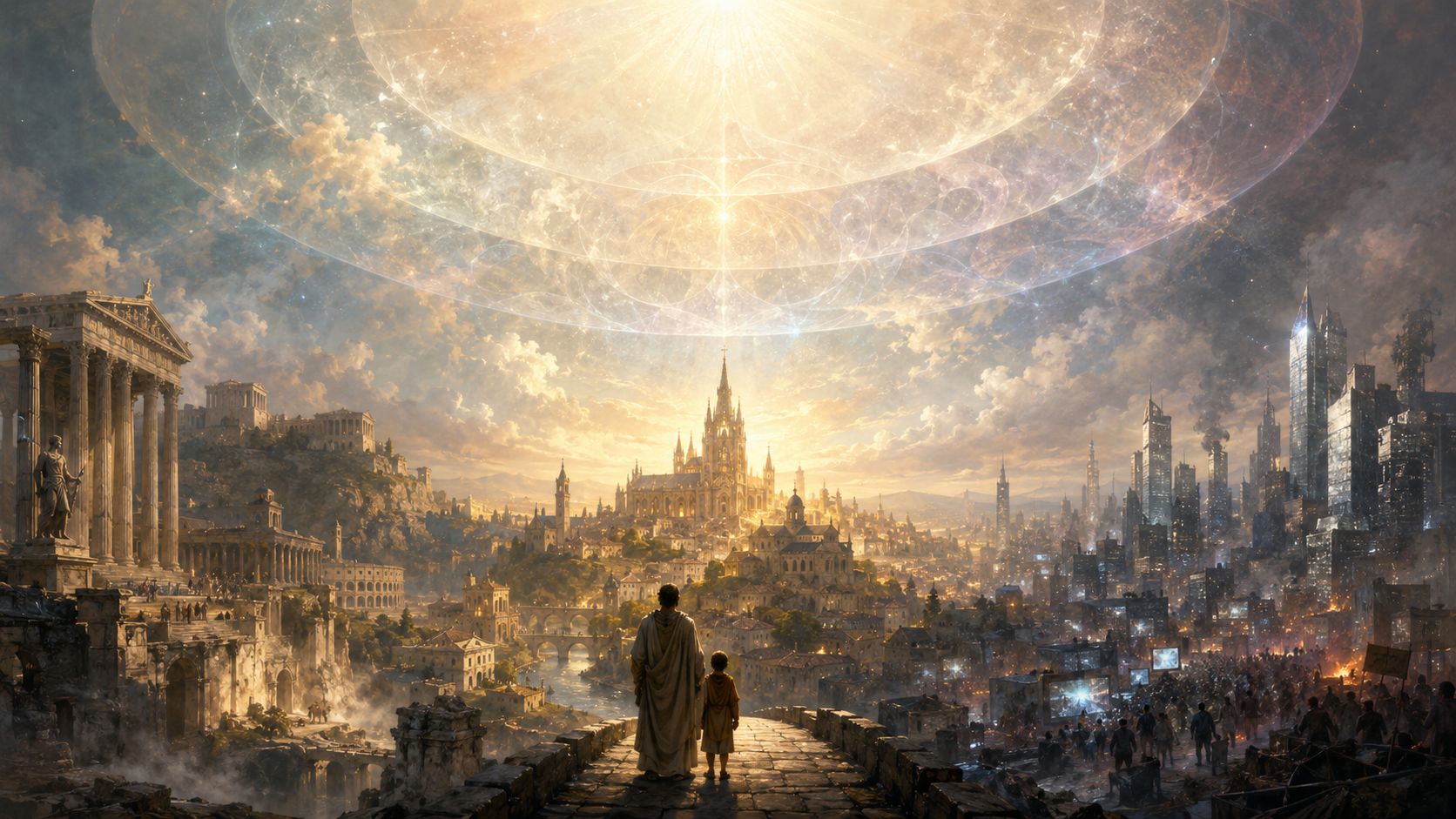
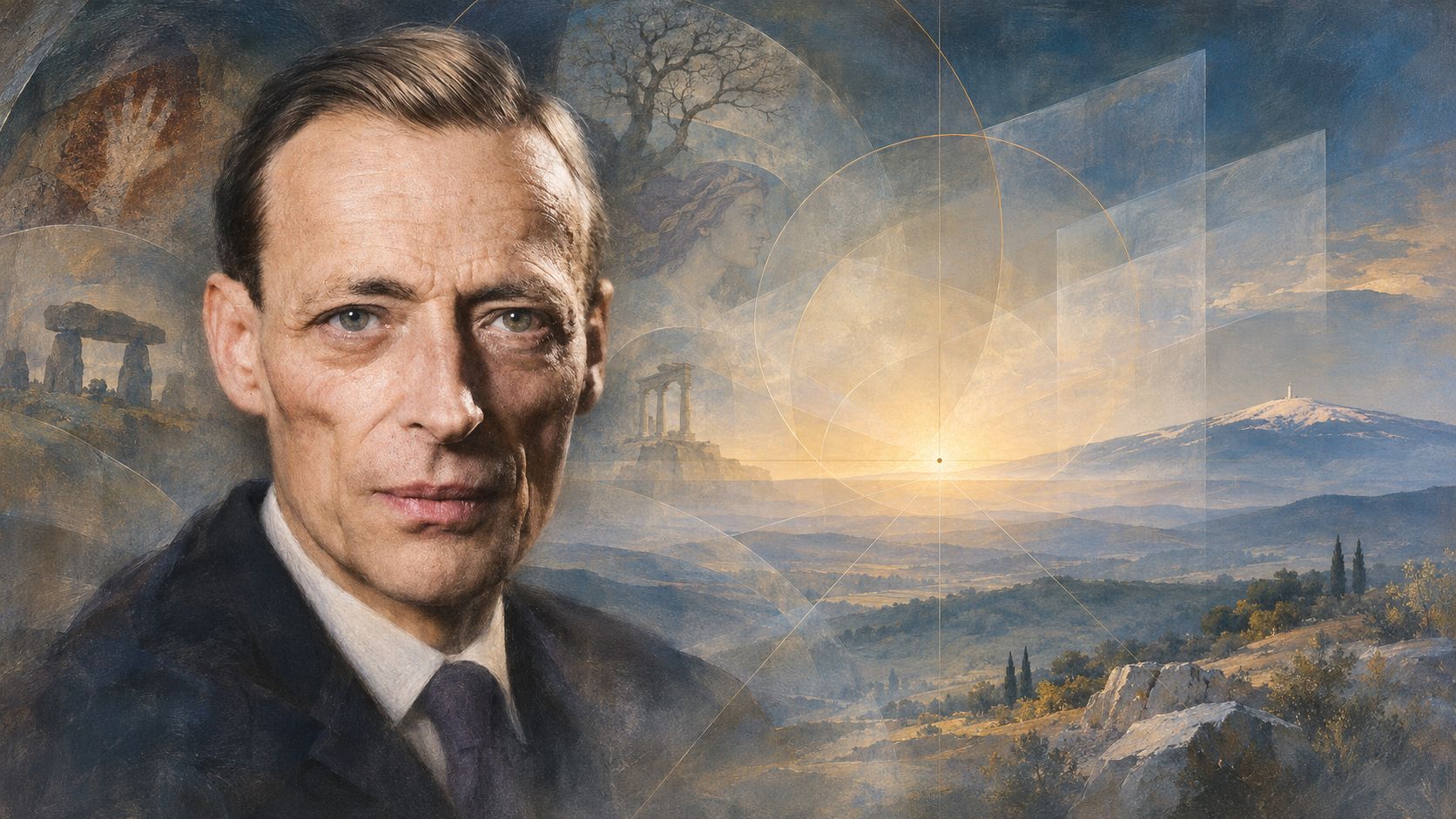
In 1949, the first volume of Jean Gebser’s Ursprung und Gegenwart appeared in German. Few people read it at the time, but many now regard it as one of the most original studies of human consciousness written in the twentieth century. The title means “Origin and the Present”. The second volume followed in 1953, and the English translation, The Ever-Present Origin, appeared in 1985. Gebser’s central question was how the way human beings experience the world has changed over the course of history, and what kind of consciousness might be emerging in our own time.
A life between worlds
Jean Gebser was born in 1905 in Posen, now Poznań in Poland. In 1931, after encountering the Nazi Brownshirts in Munich, he left Germany. He went to Spain with little money, learned the language and became a friend of Federico García Lorca. In the autumn of 1936, during the Spanish Civil War, he fled Spain for France. He spent the following years in Paris, in a circle that included Picasso and Malraux, and reached Switzerland at the end of August 1939, two hours before the border closed. He became a Swiss citizen in 1951 and died near Bern in 1973.
The central idea of his main work came to him in 1932. He spent the following seventeen years testing it against an immense range of material: mythology, linguistics, the history of art, poetry, music, physics, biology, psychology, law and economics. The result is a large and demanding book. Its central ideas, however, can be stated clearly.
Origin is ever-present
The book opens with the sentence “Origin is ever-present.” Gebser distinguishes origin from a beginning. A beginning belongs to time and lies somewhere in the past. In his account, origin precedes time and remains present in every moment. He draws attention to the German word Ursprung: Ur-sprung, the primal leap. Everything that has unfolded in human consciousness has sprung from origin, which has never ceased to be accessible.
The present, in Gebser’s sense, is more than the passing moment. It is the whole of time made present: the past that continues to shape us and the future already latent in us. A person who becomes aware of origin and the present in this full sense, Gebser writes, goes beyond beginning and end and beyond the mere here and now.
Mutations rather than evolution
Gebser distrusted the familiar ideas of progress, development and gradual evolution. He argued that decisive changes in consciousness occur in leaps, which he called mutations. A mutation is a sudden, discontinuous change, though we recognise it only after it has become sufficiently evident. The smooth line of progress we draw afterwards is a construction we impose on overlapping events.
Gebser stressed that the mutations he describes are spiritual rather than biological. He contrasted biological adaptation, which he associated with specialisation and a narrowing of possibilities, with a mutation of consciousness that adds a new dimension without abolishing the earlier ones. To express his view that the spiritual precedes the organic, Gebser used a striking image: first there was light and then the eye, first the word and then the speaking mouth, first the thought and then the brain capable of reflective thinking.
He also avoided the words “level” and “stage”, because they suggest a spatial hierarchy. He spoke of structures. The earlier structures do not disappear when a new one emerges. They remain active in each of us as constituent forms of consciousness. In Gebser’s view, much of human behaviour becomes easier to understand once we recognise which structure is at work.
The five structures of consciousness
Gebser distinguishes five structures. Each has its own relation to space and time, its own characteristic symbols and its own way of experiencing the world. He also associates them with states of consciousness, from deep sleep to integral awareness. The dimensions in the table describe the structures’ relations to space and time within his model.
| Structure | Dimension | Character and symbol | Associated state and mode of awareness |
| Archaic | Zero-dimensional | Identity, original wholeness | Deep sleep |
| Magic | One-dimensional | Unity, the point, pars pro toto | Sleep; direct participation |
| Mythical | Two-dimensional | Polarity, the circle | Dream; inner experience |
| Mental | Three-dimensional | Duality, the triangle, perspective | Wakefulness; representation and conceptual thought |
| Integral | Four-dimensional (including time) | Integrality, transparency | Awareness of the whole; verition |
The archaic structure. This structure stands closest to origin and may be identical with it. Here human beings and the universe are not yet distinguished, and the soul is still dormant. Gebser compares it to the biblical paradise. He finds traces of it in mythical images such as the primordial human being and androgyny.
The magic structure. With the magic structure, human beings begin to separate from the whole. Their consciousness is still sleep-like, centred more in the surrounding world than in an individual self. The world appears as a field of points, each of which can stand for the whole. Gebser calls this pars pro toto: the part stands for the whole and can replace it. Everything is connected with everything else, and there is as yet no clearly defined individual ego. Human beings in this structure respond to the forces of nature with forces of their own. Through spells, totems and taboos, they try to influence nature and free themselves from its overwhelming power. Gebser connects the word “magic” with words such as “make”, “might” and “machine”. For him, the magic structure is realised through direct participation in the world, rather than through a mental representation of it.
The mythical structure. The mythical structure brings the awakening of the soul and of the inner world. Its symbol is the circle, the age-old symbol of the soul. It is organised around polarities: day and night, summer and winter, the underworld and Olympus. These poles complement each other and alternate, as the seasons do over the course of a year. Time in this structure is rhythmic and cyclical, and its natural expressions are myth, image and imagination. The magic structure is lived through direct participation; the mythical is experienced inwardly, as we experience a dream.
The mental structure. Gebser places the emergence of the mental structure in Greece around 500 BC, with a renewed emergence in Europe around AD 1250. He notes that the first word of the Iliad is mēnin, referring to the wrath of Achilles, and associates it with the emergence of the mental structure. Here human beings step out of the protective circle into three-dimensional space. Thinking becomes directed. The Latin ratio links calculation with reasoning. The world divides into subject and object, and the ego becomes the centre from which the world is viewed. Mental consciousness understands the world through representations and concepts.
The integral structure. This is the structure Gebser saw emerging in his own century. He called its way of experiencing the world “aperspectival”, a term explored below.
Efficient and deficient forms
Gebser distinguishes between efficient forms, in which a structure’s capacities are fully expressed, and deficient forms, in which they become distorted and destructive. In the magic structure, he distinguishes efficient spell-casting from deficient sorcery. In the mental structure, the efficient phase is characterised by measured, clear and directed thinking. He calls its deficient phase “rational”, using the word for reason that claims exclusive validity. In this phase, thought divides the world into ever smaller sectors, reduces quality to quantity and isolates the individual ego. Gebser also saw in the modern age a pervasive anxiety about time: the feeling that it is a scarce possession slipping away, that we are always short of it.
His criticism concerns reason’s claim to exclusive authority and the consequences of allowing one structure to dominate after its creative period has passed.
Petrarch on Mont Ventoux
One of the most memorable passages in the book concerns a letter. In 1336, Petrarch climbed Mont Ventoux near Avignon and described the ascent in a letter to the Augustinian theologian Dionigi da Borgo San Sepolcro, who had encouraged his appreciation of Augustine’s Confessions. Gebser interprets the letter as marking the discovery of landscape in European consciousness: space becomes something that can be contemplated as a reality in its own right. Petrarch was shaken by what he saw. On the summit, he opened Augustine’s Confessions and turned his attention back to God and to his own soul.
For Gebser, this moment marks the dawn of the perspectival world. Painting followed the same path, from the gold backgrounds of medieval art through Giotto to the full mastery of perspective around 1500. Perspective gave European humanity an extraordinary power over space, helping to make modern science and technology possible. It also brought a loss. In Gebser’s account, human beings increasingly treated the world as something to possess, viewing it from a fixed point and dividing it into sectors. He regarded this transformation as both a gain and a loss, and doubted that we had proved equal to the responsibility it brought.
The crisis of our time
Gebser wrote his preface in 1949, and its tone is grave. He saw a crisis that went beyond morals, economics, ideology, politics or religion and extended across the whole planet. He saw technical capability growing while human responsibility diminished, and he expected a turning point within a few decades. “If we do not overcome the crisis it will overcome us,” he wrote.
He also identified two inadequate responses. One seeks a solution in ever more rational analysis, quantification and synthesis. The other seeks it in a return to the irrational, reviving magical and mythical forms that have long passed their efficient phase. Gebser held that both approaches lead back to where they started. A new structure cannot be reached by reactivating the earlier ones, and it cannot be produced as a synthesis of opposites. What is needed is a leap, a new mutation.
The integral structure and the aperspectival world
Gebser called the emerging world “aperspectival”, just as he called the new mode of thought “arational”. The prefix a- indicates freedom from a limitation. The unperspectival world of the Middle Ages had not yet developed perspective. The perspectival world of the modern age was bound to a single fixed viewpoint. The aperspectival world is free of that fixation and can encompass many viewpoints at once. In the same way, the arational stands free of the opposition between the rational and the irrational.
One of Gebser’s favourite illustrations came from Picasso. In some of Picasso’s drawings, we see a figure from the front, the side and the back at the same time. Ordinarily, a viewer would have to walk around the figure and mentally assemble views seen at different moments. Gebser interpreted their simultaneous presence in the drawing as the entry of time into the picture as a fourth dimension, making space and the body transparent. He found signs of the same tendency in many other fields of his century: relativity and quantum physics, biology and depth psychology, music, architecture and poetry, with Rilke as one of his principal examples.
Three concepts help to clarify the integral structure.
Transparency. Gebser’s own term is diaphaneity, from the Greek for “shining through”. He formulated it as a guiding principle: transparency is the form in which the spiritual manifests itself. In integral consciousness, the world and the human being become transparent to origin, allowing its presence to be recognised. Gebser paired this with a second principle: latency is the demonstrable presence of the future. For him, what has yet to become manifest is already present and at work.
The concretion of time. By “concretion”, Gebser means making something present in concrete experience. Mental consciousness treats time as a measurable line, divided into segments and spent like money. Integral consciousness experiences past, present and future together as a whole. Gebser called this “time-freedom”: freedom from the restrictive relation to time that produces the anxiety of the deficient rational age.
Verition. Each structure has its own mode of awareness. The magic is lived through direct participation, the mythical is experienced inwardly, and the mental is grasped through representations and concepts. The integral mode can be described as integral awareness of reality: perceiving the world as a whole, with an awareness of its interconnections and our own participation in it. Gebser called this capacity verition, which he understood as perceiving and imparting truth in a single act. In his account, it allows origin to become perceptible in the present. Gebser insisted that this is an act of the whole person; he distinguished it from both intuition and any supposed supersensory faculty.
Integration means making all structures present
The integral structure integrates the earlier ones, which remain active within it. Gebser defined integration as the re-establishment of the pristine state of origin, enriched by everything that has been achieved since. In practice, this means becoming aware of the magic, mythical and mental structures, each in its proper place and with its proper weight. We need the magic bond with nature and community, the mythical life of the soul and its images, and the clarity of mental thought. None of them should rule alone. In Gebser’s terms, a person who integrates them becomes aware of origin within the present.
Gebser was careful to say that his book offers neither a new image of the world nor a new worldview. A new worldview would only be another construction of the mental structure. What he describes is a change in perception that each of us has to realise for ourselves.
Why Gebser matters now
More than seventy-five years after the first volume appeared, Gebser’s diagnosis remains relevant. The fragmentation of knowledge into specialised sectors, the reduction of human beings to data, the sense that time is constantly running out, and the simultaneous appeal of irrational movements are all familiar to us. His hope also remains relevant: he discerned signs of a new consciousness in science, art and everyday life long before the language of a “paradigm shift” became common.
For Quintessence Forum, his work holds particular interest. Our discussions of consciousness, philosophical idealism and a holistic understanding of the human being address many of the questions Gebser explored. He offers us a way to value reason without making it absolute, to take the magic and the mythical seriously without regressing into them, and to regard the present crisis as the threshold of a transition. Those of us who work with the whole human being, in medicine, psychology or education, may recognise in his integral structure an approach that informs our own work.
Further reading
Jean Gebser, The Ever-Present Origin, translated by Noel Barstad with Algis Mickunas. Athens, Ohio: Ohio University Press, 1985. Original edition: Ursprung und Gegenwart, Stuttgart: Deutsche Verlags-Anstalt, 1949 and 1953.