
Many of us have friends who believe that the world is controlled by a hidden group of powerful people. They read about elites, paedophile networks and bankers; sometimes Jews are mentioned as well. Often, these are good and sensitive people. We do not want to condemn them. We want to understand what it is they are actually perceiving.
It is often said that every conspiracy theory contains a grain of truth. Let us try to find that grain. Crimes committed by the powerful and networks of corruption do exist. The Epstein case was not a fabrication. Yet this alone does not explain the impression shared by millions of people around the world: that behind individual events there is something coordinated, intelligent and malevolent, something that transcends the people directly involved.
This intuition may be valid. The error begins with its interpretation, when this something is identified with a particular group of people.
A Phenomenon with Many Names
Across continents and millennia, human cultures have known of a force that attacks the mind from within. The Cree call it wetiko; other Algonquian peoples speak of the windigo, a spirit of cannibalism that drives those it possesses to consume the life force of others.
The Native American scholar Jack D. Forbes wrote about it in his book Columbus and Other Cannibals. He described wetiko as a psychic disease, the oldest and most destructive epidemic in human history.
Hawaiian kahunas speak of beings called ’e’epa. In the early centuries of the Common Era, the Gnostics wrote of archons that deceive the human mind. Buddhism knows Māra, the tempter who works through our desires and fears. The Kabbalah speaks of the qlippoth, shells that imprison sparks of light. The Christian tradition knows demons and the Devil. Slavic folklore has the vampire, a dead being with no life of its own that survives by drinking the blood of the living. Beings that drain the life force appear in one form or another in almost every culture in the world.
The Western esoteric tradition speaks of egregores, collective thought-forms that acquire a life of their own. Jung wrote about autonomous complexes and psychic epidemics, which he considered more dangerous than natural disasters.
As early as 1967, Colin Wilson published his novel The Mind Parasites. Philip K. Dick spoke of the Black Iron Prison, an invisible empire that keeps humanity asleep. Paul Levy, who built upon Forbes’s work and brought many of these traditions together in his books on wetiko, uses the expression “mind virus.”
The recurrence of such similar accounts across widely separated cultures suggests that humanity has repeatedly encountered the same underlying experience.
What—or Who—Is It?
Naturally, we ask what kind of thing wetiko actually is. A being? A disease? A metaphor?
Levy argues that wetiko evades precisely the kind of question we are accustomed to asking. Materialist culture recognises only two possibilities: either something exists objectively as an entity in space, or it is a fabrication. Wetiko belongs to neither category. It cannot be placed under a microscope, yet it is not merely something we have imagined.
We can approach its nature from three different directions.
Psychologically, wetiko resembles what Jung called an autonomous complex. A part of the psyche splits off, most often following shock or trauma, and begins to live a life of its own. It behaves like a foreign body within us, as though it possessed its own will and purpose. It can be suppressed by force of will, but it cannot be reasoned away, and at the first opportunity it returns with its former strength.
When such a complex grows powerful, it establishes something like a shadow government within the psyche. The ego believes it is in control, yet someone else is making the decisions.
Wetiko may be understood as such a complex on the scale of humanity as a whole: a split-off, unconscious part of the collective psyche that acts as though it were an independent being.
Ontologically, wetiko possesses the kind of existence that Henry Corbin called imaginal: the reality of an intermediate realm that is neither material nor imaginary.
Levy uses a precise image. A reflection in a mirror is neither the mirror itself nor the object being reflected, yet we truly see it and it genuinely affects us. Wetiko exists in a similar way: it is real, but derivative, without an independent substance of its own.
This is the same mode of being attributed to the daimons of ancient traditions. Wetiko could be described as a dark daimon, a being of the intermediary world that lives on the boundary between mind and matter.
Energetically, wetiko follows the logic of the vampire.
It possesses no source of life of its own. In itself, it is nothing. It exists only in relation to us, sustained by our energy, our fear, our hatred and our unconsciousness. If we ceased feeding it, it would disappear.
The virus and the vampire are therefore among its most accurate images. Both are empty forms animated entirely by the life of another.
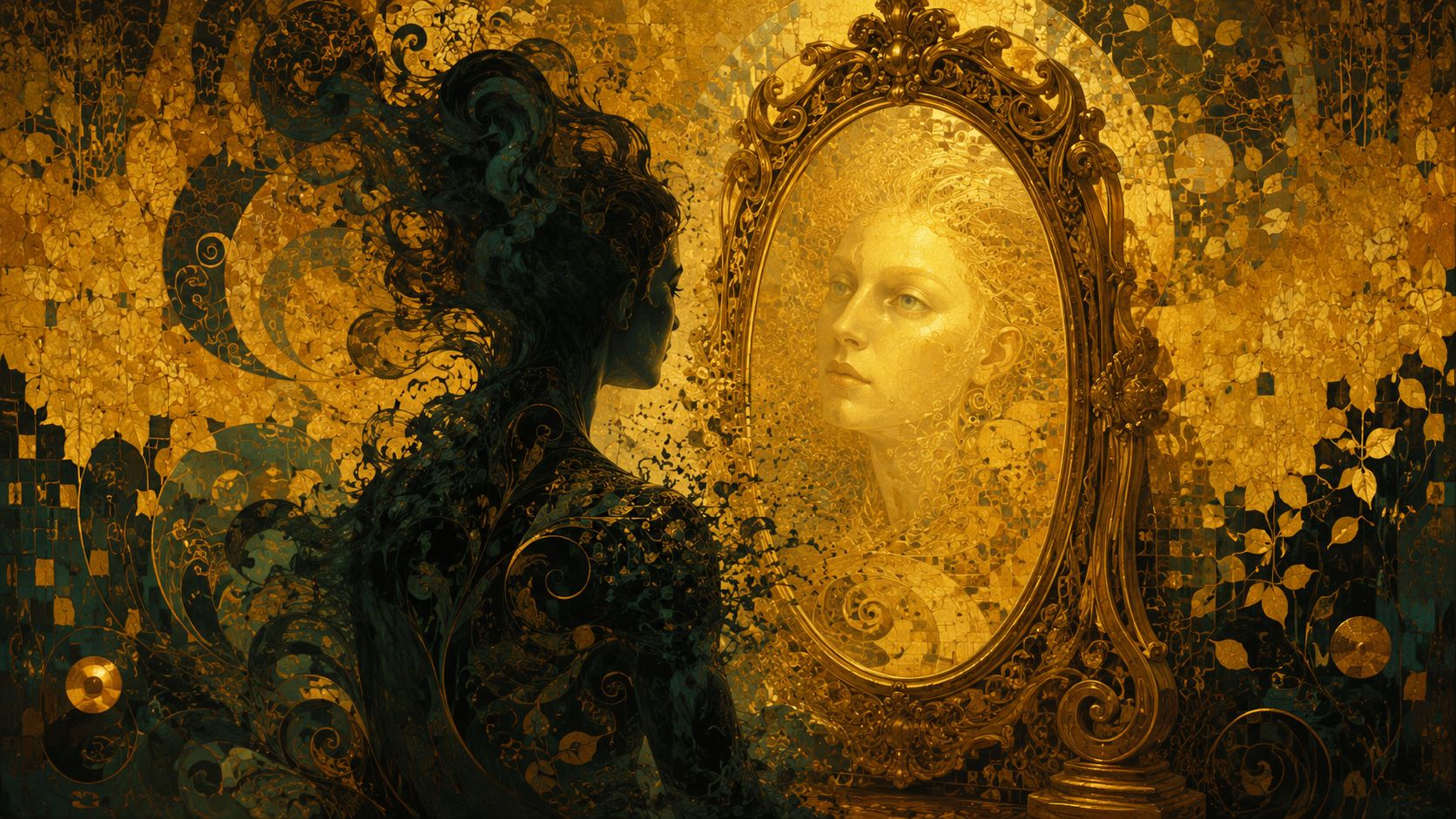
Levy also recalls a familiar detail from vampire legends: a vampire casts no reflection in a mirror. When we look into the place where its reflection should appear, we see only ourselves.
Folk imagination could hardly have created a more exact image of the truth about wetiko. When we search for its face, we find our own.
Wetiko lives in the space between us: in our relationships and in the collective field that we create together from moment to moment. No one possesses it alone, yet all of us participate in it.
Levy adds a paradox worth remembering. Anyone who believes that wetiko exists objectively as an external power has already fallen into its trap, because they have made it into another enemy outside themselves. Anyone who declares that nothing of the kind exists falls into the same trap from the opposite direction, because they leave it free to operate unnoticed.
Jung offers a more sober criterion than the question of existence: what produces effects is real. Wetiko produces effects. Its traces can be seen throughout history and in the news of our own time.
Something else follows from its peculiar nature. Wetiko cannot be observed directly, just as an archetype or an elementary particle cannot be observed directly. A physicist does not see the particle itself, but knows it through the effects registered by a detector and can still speak about it with precision.
We recognise wetiko in the same way: through its effects, through the signature it leaves in history and in our own minds. We must therefore speak primarily about what it does and what sustains it. With this kind of reality, a description of its effects may be the closest we can come to describing its essence.
How the Virus Operates
The common core of all these descriptions is simple: this malevolent force does not attack us from outside. It works through our blind spots and through the shadow, the parts of ourselves that we do not want to see.
Its most effective instrument is projection.
We project the darkness we cannot see within ourselves onto someone else. It is no coincidence that the Devil is called the accuser. The Hebrew word satan means an accuser or adversary in a court of law.
We accuse others of what we ourselves are doing unconsciously, as though we were looking into a mirror and attacking our own reflection.
Hannah Arendt identified dehumanisation as one of the fundamental mechanisms of totalitarianism. To hate another person with a clear conscience, we must first cease to perceive them as human.
Throughout history, propaganda has therefore described those selected as guilty as parasites, vermin, infection, cancer or filth that must be removed.
It is worth noticing that conspiracy websites today use exactly the same language to describe the supposed rulers of the world. The rhetoric of parasites draining humanity of its life force directly reproduces the description of wetiko itself.
The shadow describes itself and attributes its own image to another.
The anthropologist René Girard devoted his life’s work to the mechanism of the scapegoat. He called it the satanic principle and described its sophisticated drama.
The force first creates disorder, spreads scandal and deepens division. At the height of the crisis it has created, it offers a solution: someone to blame.
Once the supposed culprit has been expelled or destroyed, temporary peace returns to the community. This convinces everyone that the guilty party was correctly identified. The lie deepens and eventually demands another victim.
The cycle continues until someone sees through it.
This brings us back to conspiracy theories. A person who believes that the world is controlled by a small group of evil people may be correctly perceiving the activity of an impersonal evil. But then they project it onto a particular group and begin to hate and fear its members.
At that moment, they themselves become an instrument of the force they intended to fight.
Hatred and fear are the nourishment on which this force lives. The Buddha counted hatred among the three poisons of the mind, while Levy calls it the high-octane fuel of projection.
The history of the twentieth century demonstrated this in its full horror. As early as the 1930s, Jung described Nazi Germany as a nation possessed by an archetype, which he named after the ancient Germanic god Wotan.
Millions of otherwise decent people were taken over by a collective psychic force, while believing that they were fighting against parasites threatening their nation.
A Divided Society
The same mechanism helps explain the polarisation we experience today in our families, among friends and throughout society.
Levy describes a mutual projection of the shadow. Each side projects its darkness onto the other and then unconsciously needs the opponent to behave badly. Only in this way can it continue to affirm its own innocence.
Both sides see themselves as victims. Both have a clear conscience. Both feed the conflict with their energy.
Levy compares this entanglement to an elastic cord. The more violently the two sides push away from one another, the more tightly they remain bound together.
The divisions between the vaccinated and the unvaccinated, liberals and conservatives, East and West, are fed by the same force from both sides.
It does not need one camp to win. It is nourished by division itself. The word diabolos means the one who divides.
Anyone who understands that the real adversary does not stand in either camp ceases to be a piece in this game.
Two Dead Ends
There are two opposite ways of losing our way when dealing with this subject.
The first dead end is denial.
It is said that the Devil’s greatest trick is convincing people that he does not exist. Materialist culture accepts as real only what can be measured and weighed, and therefore excludes such phenomena in advance. Talk of demons and mind viruses sounds like superstition to the modern person.
Levy observes that precisely this wholesale denial gives such forces a free field in which to operate. What no one sees and no one names can act without resistance.
Yet the experience we are describing is familiar to all of us, regardless of the language in which we describe it or whether we believe in such things.
The second dead end is finding a new culprit.
If we declare that the world is controlled not by Jews or elites but by demons, we may simply repeat the same mistake one level higher. Evil remains outside us, we preserve our innocence, and we acquire a new enemy—this time an invisible one.
The wiser traditions warn that this force has no existence independent of our consciousness. It feeds upon our unintegrated shadow, our unconsciousness and our fear.
We can test our understanding with a simple question:
Does this view lead me to examine my own inner life, or does it merely offer me another external culprit?
Darkness Hidden in the Light
There is a warning here for people on a spiritual path as well. Both Jung and Levy remind us that darkness can conceal itself within light.
The more completely a person identifies with their luminous side and strives to be only good, loving and positive, the more deeply their shadow may sink into the unconscious. There it gradually gathers strength.
People determined to be good at any cost often have someone around them who is forced to carry all the evil they have split off from themselves.
Spiritual communities that speak exclusively of love and light can therefore be surprisingly vulnerable to conspiracy thinking. The rejected shadow returns in the form of dark forces said to be ruling the world.
Wholeness arises when we know our shadow, acknowledge it as our own and refuse to let it govern us from the unconscious.
What Can We Do?
The first step is to see and name.
Wetiko operates as long as it remains invisible. This is why so many cultures have given it a name.
Levy adds an interesting thought. Although wetiko has no independent existence outside our consciousness, it can be helpful to imagine it as a being with an intention. By naming the disease, we restore a conscious relationship to its energy.
Diffuse, nameless evil becomes something with which we can engage consciously.
The second step is not to be afraid.
Sri Aurobindo, whom Levy cites, wrote that fear is precisely what we must not feel in the presence of such forces, because it makes them bold and aggressive. Fear tunes us to their frequency.
Those who fear demons are already serving them.
The third step is not to fight.
This sounds paradoxical, yet direct combat with this force strengthens it. It feeds upon polarisation, and conflict is one of the forms polarisation takes.
Philip K. Dick wrote that the Empire can transform every effort toward freedom into a new tyranny. Revolutions that hated tyrants have often produced new tyrants.
Hatred of evil delivers us into the hands of evil because we begin to use its own methods.
Resistance and vigilance are necessary, but they must not be accompanied by hatred or fascination with the enemy.
The fourth step is not to give evil more attention than necessary. Excessive preoccupation with it draws us into its atmosphere.
We must, however, distinguish between two attitudes that may look similar from the outside.
To look away out of fear is avoidance, and avoidance feeds the disease. But when we recognise the darkness, acknowledge its presence, and then freely turn our attention from our own centre towards what we wish to create, we begin to starve it.
We are sovereign beings, and our attention is ours to direct.
Levy compares this process to morning dew evaporating in sunlight. The light of conscious attention dissolves these parasites of the psyche back into the empty field from which they arose.
The fifth step is to remain in our centre.
Levy uses the image of the eye of a hurricane. At the heart of the most violent storm, there is a place of stillness.
Our true nature resembles a mirror that reflects even the ugliest image while remaining unstained. Those who rest in their true nature remain beyond the reach of such forces.
Aurobindo adds that a deep knowledge of our own being provides a protection that never fails.
The sixth step is to create.
Wetiko devours life. Creativity renews it, and is therefore its direct opposite.
Levy recommends placing the energy we would spend fighting darkness into building the kind of world in which we wish to live. When we express our nature creatively, nature itself speaks through us.
This need not involve great works of art. It can be anything through which we bring more into the world than we take from it: a garden, a craft, a song or an act of help offered to another person.
The seventh step is community.
Levy leads groups of people who help one another to awaken. He describes them through a play on words that is particularly appropriate in an article about conspiracies.
The Latin word conspirare literally means “to breathe together.” In its original sense, conspiracy therefore means a shared breath.
Instead of imagining a conspiracy of dark forces, we can create a conspiracy of light: a community of people who breathe together, inspire one another and help one another remain awake.
The eighth step is compassion.
If wetiko is a disease, as Forbes described it, then people under its influence are ill. The sick do not need hatred. They need healing.
This applies both to powerful people who commit evil and to friends who have become lost in conspiracy theories.
Compassion also protects us. Wherever compassion is present, hatred—the principal fuel of this force—has nothing to take hold of.
Why Does It Exist?
One question remains: why would God or the universe allow such a thing to exist?
Mystics offer a surprising answer: the greater the light, the greater the darkness that rises against it.
According to his own letters, Padre Pio endured physical attacks by demons. St John of the Cross described the dark night of the soul through which those who have drawn close to their goal must pass.
It is as though difficulty were a form of training without which the soul could not mature.
A Native American teaching says that the medicine is hidden within the pain itself. We need only look into it deeply and quietly enough.
Levy goes even further. Among the four forms of blindness caused by wetiko, he includes the inability to recognise that wetiko may itself be a revelation.
By showing us our darkness, it also reveals the greater whole that we might otherwise never see. The darkness within us becomes the background against which our light can appear more clearly.
These forces indirectly introduce us to a power within ourselves that is greater than they are.
The disease that humanity has collectively dreamed into existence can also be dreamed differently together.
A blessing is hidden within the curse. Without this trial, we might never learn who we truly are.
We can therefore look upon friends who believe in conspiracy theories without a sense of superiority. They are responding to a genuine signal; they are simply searching for its source outside themselves.
The best thing we can do, both for them and for ourselves, is not to add more fear and accusation to the collective field.
We will not save the world by fighting darkness.
We will save it by keeping the light alive within ourselves, by creating, by breathing together with people of goodwill, and by preserving compassion even for those who have lost their way.
Podľa potreby sa dá ešte doladiť anglický titulok, perex a meta description tak, aby článok lepšie fungoval vo vyhľadávačoch a na sociálnych sieťach.