

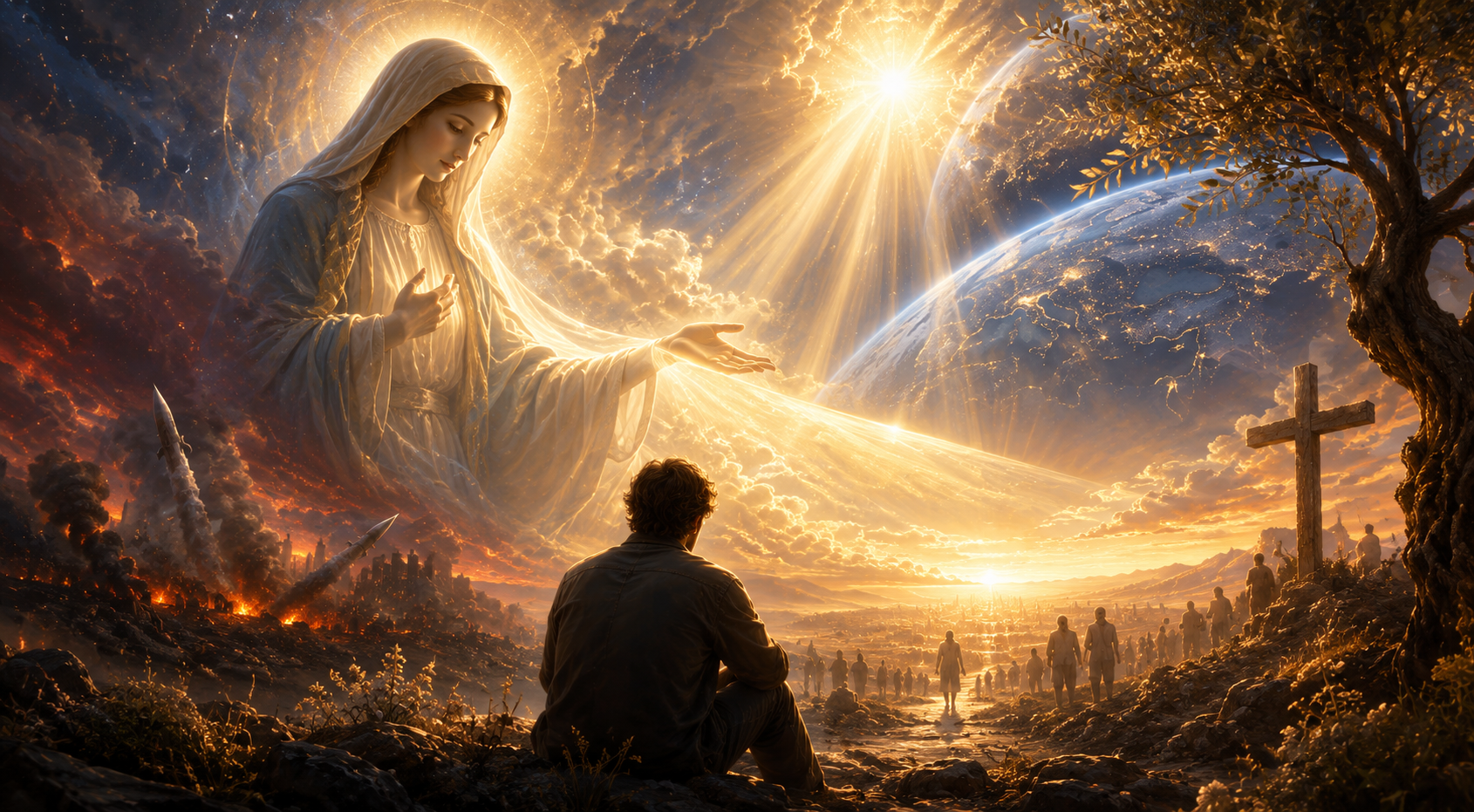
On weeping Madonnas, near-death experiences, and the God who is love
Only recently did I learn about Sister Agnes Sasagawa, the Japanese nun who in 1973 received messages from the Virgin Mary. Later, according to witnesses, a wooden statue of the Virgin Mary repeatedly wept, bore bloody stigmata and exuded a fragrant perspiration. The message was severe: prayer and repentance, otherwise fire would fall upon the world and a large part of humanity would perish. It made an impression on me. It is the same message as Fatima.
Yet I also perceive another reality, another kind of experience: thousands of documented testimonies from people who have gone through near-death experiences. Most of them do not speak of wrath, but of light, acceptance and infinite love. They speak of all of us being connected, immersed in one great consciousness. Many return with the certainty that God is love.
This creates a tension that every thinking believer probably knows. On one side, the weeping Madonna and the warning of fire from heaven, in which much of humanity will perish. Fatima, Akita, severe prophecies. On the other side, the ocean of love described by those who for a moment touched the other shore. Which image is true? A God who threatens punishment, or a God who is pure love?
I will allow myself a heretical thought. These severe apparitions sometimes look as if two gods stood behind them. An angry Father who wants to deal with the world, and a merciful Mother who restrains him. This is exactly what the old Gnostics claimed: that over this distorted world rules a lower, jealous god, while the true God of light stands beyond him. There is something attractive about this idea. Evil could then be explained. It would not belong to the true God.
Yet the Gnostic path turns matter and the body into a prison from which one must escape. And I am a doctor. I have spent my whole life healing bodies. I cannot live within a worldview that says the body is a mistake and a prison. Something in me refuses that.
There is a third possibility. An old one, and to my mind a deeper one. There are no two gods, only one reality of love. And what looks like wrath is that same love when it meets a hardened and closed heart. Isaac the Syrian, one of the fathers of the Christian tradition, said that hell is not another place with another god. It is God’s love experienced by the one who has closed himself to it. The same fire is light and warmth for an open heart. For a closed heart it burns. If this is so, then the fire of Fatima and the infinite love of near-death experiences are not two gods. They are the same fire, seen from two sides.
Apparitions do not come as a pure recording from heaven. They come through a human being. Through simple children in Portugal, through a nun in Japan. Whatever they touch must be translated into the images available to those people. Into their language and culture. The Church itself teaches that private revelations do not add to or improve the faith. The image of fire and the image of the Mother restraining the Father’s anger need not be a literal plan of how things work in God.
The fire that destroys almost everyone looks quite different when it is not God’s punishment, but the fire we ourselves ignite. The year 1917: the First World War, totalitarianism on the horizon, and another war ahead. The year 1973: nuclear arsenals aimed at one another on both sides. Repentance, then, is not a bribe offered to an angry deity. It is metanoia, a turning, a change of direction, without which humanity will destroy itself by its own hand. And the Mother who restrains the Father is an image of mercy giving us time.
And now the most heretical thought of all. You may know the British author Patrick Harpur and his book Daimonic Reality. Harpur speaks of daimonic reality, of a world that is neither purely external and material, nor purely internal and invented. It is an in-between world. Henry Corbin called it mundus imaginalis, the imaginal world. We must be careful with words here. Imaginal is not the same as imaginary. Imaginary means invented, unreal. Imaginal means real, yet real in a different way than a stone or a table. It is a realm that is just as real, but it is approached through imagination rather than measurement and weight.
Harpur says that this reality always appears in a form that a given age and culture can receive. To a medieval villager, it appeared as fairies and spirits. To a modern secular person, as extraterrestrials and flying saucers. To a Catholic, as the Virgin Mary. The same depth, each time in a different costume. Real, yet never literal.
This is truly a heretical thought, because dogmatic theology does not speak about Fatima in this way. I admit that openly. Yet notice what this perspective gives us. It refuses the literalism of both extremes. The believer who says it was a literally physical visit from the Mother of God. And the skeptic who says it was only a crowd of hallucinating people. Harpur would say that Fatima is neither a photograph of heaven nor a mass delusion. It is the soul of the world speaking in a language that village could understand.
This explains, with a certain elegance, why the sacred speaks in Portugal in Catholic form and elsewhere in other forms, without any of it becoming a lie.
Let us return to the original question. Is the great consciousness described by people who have experienced clinical death God himself? Or is God still beyond it? Here I have no certainty, and no one has. I have only a map. If that consciousness simply is God, that is pantheism. If the world and that consciousness are in God, while God is also more than their sum, that is panentheism.
The mystics go even further. Meister Eckhart spoke of the Godhead beyond God, of that ultimate reality which stands beyond every concept we have, even beyond the concept of consciousness.
The most workable answer, to my mind, is that it is both. That great consciousness is the inner, near face of God. Therefore those who touch the other shore do not encounter an illusion, but real love. And God at the same time exceeds every whole that we can name. We do not have to choose.
One final objection remains, and to my mind it is very important. Are only Christians supposed to save the world from fire through the rosary and repentance? What about everyone else? Two things need to be said here. Even the Catholic Church today does not teach that only Christians will be saved. The Second Vatican Council explicitly recognizes that truth and holiness are also found in other religions. And conversion of the heart, repentance, compassion and prayer live in every great tradition, only under different names. The rosary is a dialect. The message is not a dialect. Near-death experiences happen to people of every faith and to people with no faith, and the love they describe does not ask anyone for a baptism certificate.
So have I gone astray by looking for a more modern model of the world? I do not think so. A faith that never wrestles is not deeper. Jacob wrestled all night and received a new name. Job argued with God, and in the end God defended him, not his pious friends. The test is not whether I have answers, but the fruit. Does this search make me more humble, more sensitive to the suffering of others, more capable of forgiveness? Then it is not a wrong path.
And I do not have to resolve it all now. A mature faith can bear an open question. As a homeopath, I know this well. Not every case becomes clear with the first prescription. You observe, you wait, you let the picture mature. The same patience applies here.
Perhaps in the end it is simple. People who have returned from beyond the boundary say almost unanimously one thing: at the end, what counts is not wealth or success, but how much love we gave. If this is true, then the weeping Madonna and the light at the end of the tunnel are not saying two different things. They are saying the same thing in two voices. One is urgent, the other tender. Yet it is the same fire.

