
From theurgy to the homeopathic remedy
I recently read Gregory Shaw’s Theurgy and the Soul, a study of Iamblichus. It reminded me that some of the figures who shaped European thought stay almost unknown outside circles of specialists. Iamblichus is one of them. His ideas moved through philosophy and spirituality, and by a long and indirect route, through medicine.
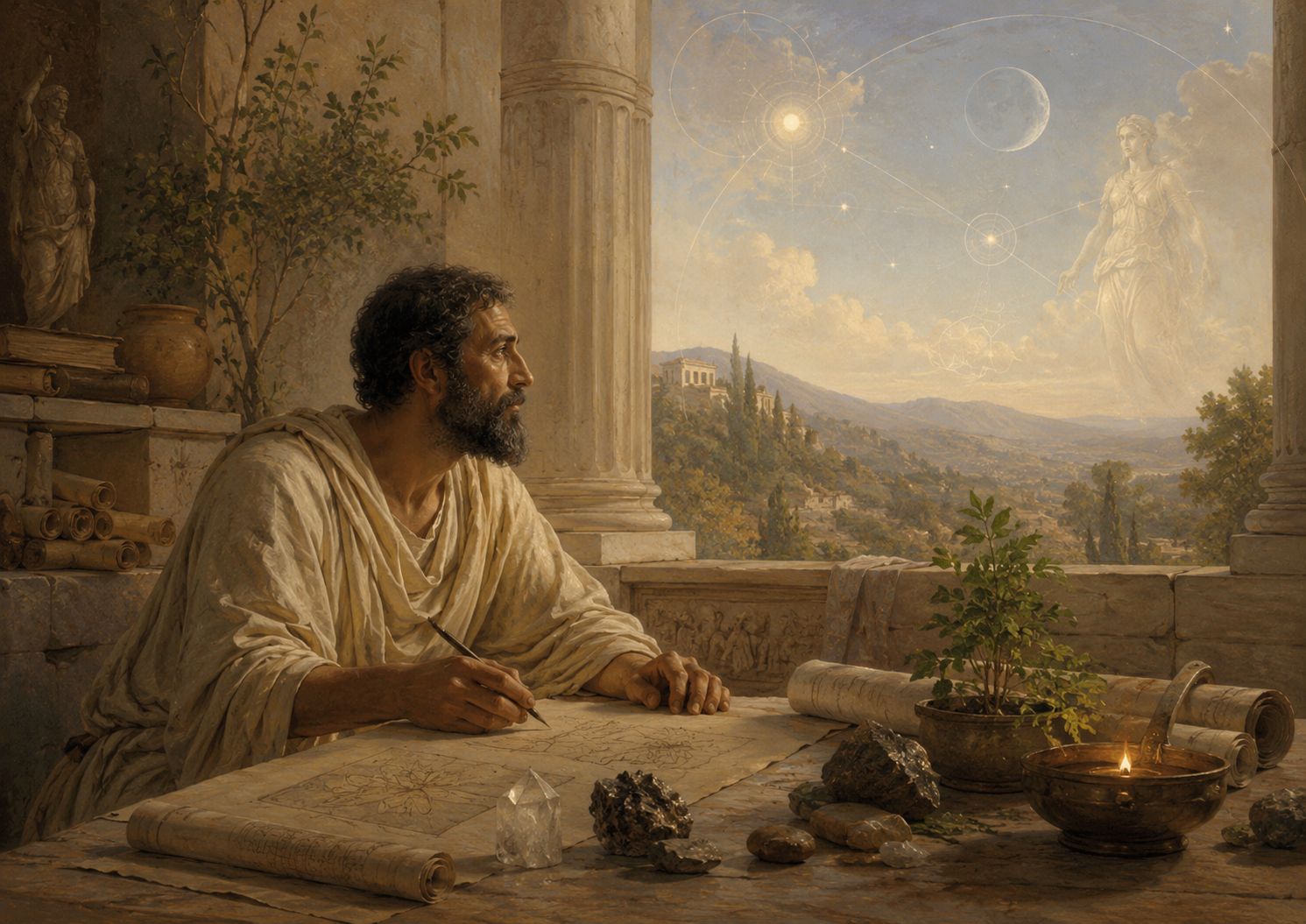
Iamblichus of Syria lived roughly between 240 and 325 AD. He belonged to the late Neoplatonists. Ancient philosophy had reached a point where it tried to understand the relation between spirit, soul, and the material world. The old religions were receding. Christianity was becoming the dominant culture.
Plotinus and Porphyry stood at the beginning of Neoplatonism. They emphasised the spiritual dimension of the human being. For them the soul could return to the highest principle of reality, the One, through philosophical knowledge and contemplation. The path to the divine ran through the intellect and inner concentration.
Here Iamblichus made a decisive move. He held that the soul descends into the material world more completely than his predecessors believed. Once fully descended, the soul cannot lift itself back by its own thinking. Philosophical meditation reaches only so far. The return requires the action of the divine itself.
This is the heart of his disagreement with Porphyry. Porphyry trusted the philosopher’s ascent. Purify the mind, withdraw from the senses, and the soul rises toward the One by its own effort. Iamblichus answered that this overrates the human position. A soul that has entered matter completely has lost the self-sufficiency such an ascent assumes. If the soul could save itself by contemplation, it would already be divine. It is not. So the initiative has to come from above. The divine reaches down to the soul through acts it has ordained, and the soul consents to them. Iamblichus called this theurgy, divine action or divine work.
Theurgy does not compel the divine. The human being places himself in the order the divine has laid down and lets that order work through him. The power at work belongs to the symbols and to the order that gave them their meaning. The practitioner supplies the consent.
These symbols Iamblichus called synthemata, tokens. A synthema is a material carrier of divine presence. It can be a ritual object, a plant, a stone, a natural substance. Each level of reality leaves a mark on the level below it. A stone or a plant is more than what it appears to be. It holds a correspondence with a higher principle, placed there by the structure of the cosmos. Used rightly, the token opens a relation between the human being and the divine order.
This picture of the world differs sharply from later rationalism. The world is not a set of physical objects. It is a hierarchy in which every level is bound to the others by correspondences. Material things carry meaning and can mediate the action of higher principles. Matter becomes one of the places where spirit reaches us.
Iamblichus shaped the whole line of late Neoplatonism. Proclus and Damascius built on him. The path into Christianity was not accidental. Much of this cosmology passed into Christian theology through the writings attributed to Dionysius the Areopagite, which carry a strong Neoplatonic and Iamblichean imprint. Medieval sacramental theology drew from them the image of a graded world in which the divine reaches the human being through material signs. The hierarchical world became one of the governing images of medieval thought.
Christian worship carries the same structure and brings it to its fullest form. In the Mass, Christ becomes present in the host. The bread and wine are transformed, and the faithful receive him. The Church defines a sacrament as a visible sign of invisible grace. This is the theurgic pattern in Christian language. A material thing becomes the bearer of a divine act, and through it the communicant is drawn toward union with God. Iamblichus had argued that the soul cannot complete the return by its own effort, that the divine has to act first. The sacrament answers that need. Here the initiative belongs wholly to God, and the gift is grace. This sets it apart from any technique a practitioner might master. The earlier tokens and the later remedy stand as lesser participations in a pattern the sacrament expresses most completely.
The line continued into the Renaissance. Marsilio Ficino recovered the Neoplatonic and Hermetic texts and translated them. For Ficino the world was again alive. Between the human being, nature, and the cosmos ran a web of correspondences. In De vita he described how natural things carry the influence of the higher order and how the physician can work with them. Theurgy had entered a medical key. The token had become the remedy.
In this soil the doctrine of signatures took its mature form. Paracelsus taught that nature marks its creatures with signs of their inner virtue. A plant, a mineral, a metal shows in its form and quality what it can do. The physician has to interpret these signatures. Behind the doctrine lies the older conviction, running back through Ficino to Iamblichus, that the outer form of a material thing carries the imprint of a higher principle. Paracelsus set this conviction at the centre of medicine. Macrocosm and microcosm answer to each other. What works in the great world can act in the small one, in the human being.
Samuel Hahnemann formulated homeopathy two centuries later, in the language of the Enlightenment and experimental medicine. His method looks empirical. He proved substances on healthy people and recorded what they produced. The frame beneath the method belongs to the older tradition.
Consider what Hahnemann does with a substance. He takes a material and works it, dilution and succussion repeated in steps, until its gross matter recedes and a dynamic quality is released. He called this potentization. Paracelsus had named the goal the quintessence, the refined essence of a substance freed from its matter. Hahnemann reached the same goal by a method. The potentized remedy is a material token that no longer acts by its bulk. It acts by the dynamic quality it carries, on the dynamic level of the sick person, the vital force.
The old intuition returns here in a precise form. A material thing mediates an action that is not material. The remedy stands in a relation of similarity to the disturbed state of the patient, and through that relation it can move it. The smallest dose, energised, carries the deepest effect. Iamblichus would have recognised the structure. A token, rightly prepared and rightly matched, opens a channel through which a higher order restores what has been disturbed.
History does not run as a single chain in which one idea passes cleanly into the next. It is a broad current that surfaces in different forms in different periods. Philosophy, religion, alchemy, medicine, and natural philosophy shape one another within it.
Seen from a distance, a continuity appears. In antiquity it lives in the Pythagorean and Platonic tradition. In late antiquity Plotinus and Iamblichus develop it. In the Middle Ages it passes into Christian mysticism and theology. In the Renaissance it returns in Hermetism and Platonism. In the early modern period it shapes Paracelsian medicine and alchemy. Some of its echoes reach the symbolic medicine we still practise.
Iamblichus is one of the important nodes in this story. In him philosophy meets ritual and material things become carriers of a higher meaning. The conviction underneath stays constant. Reality is not a heap of isolated objects. The world has an inner order in which the spiritual and the material levels touch and mirror each other. The human being can try to understand that order, and can work within it.
Vladimír Petroci
Source: Gregory Shaw, Theurgy and the Soul: The Neoplatonism of Iamblichus.
/