
From Paracelsus to the potentized remedy
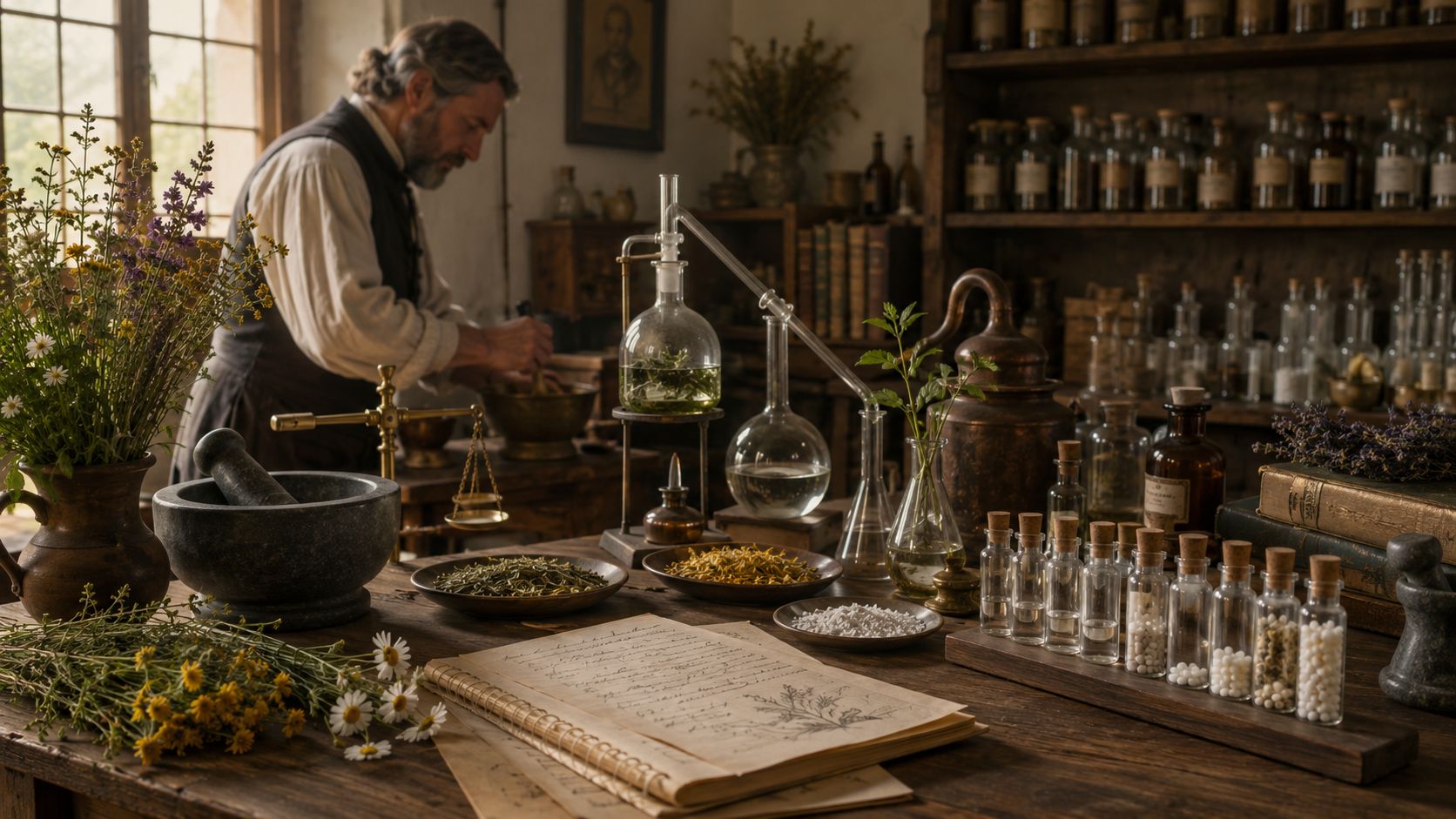
In a laboratory in southern Germany, plants are still fermented, distilled, burned to ash, and recombined by hand. The Soluna laboratory, founded by Alexander von Bernus in the last century, produces spagyric medicines to this day, and companies such as Pekana, Phylak, and Staufen-Pharma work in the same lineage. In Germany these preparations are registered as homeopathic medicines. That fact says something we tend to forget. Alchemy did not die. It kept going, changed its language, and took other names. One of those names is homeopathy.
The word spagyria comes from Paracelsus. He built it from two Greek verbs, to separate and to gather. Separate and recombine: in one word we have the whole grammar of alchemy. Dissolve what is bound, purify it, bring it back together in a finer form. The alchemists wrote it as solve et coagula. It describes a laboratory process and an inner one at the same time, and that double meaning is the key to everything that follows.
We usually picture alchemy as a failed chemistry, old men trying to turn lead into gold. That picture misses the point. The serious alchemists were not chasing metal. Jay Ramsay, in his 2017 book Alchemy: The Art of Transformation, puts it plainly: in matter they were seeking what they first had to find in themselves. The old texts return again and again to one image. The vessel is the human being. We are the flask and the fire that heats it, and the substance being worked is also us. The transformation happens in us.
The work moved through stages that the alchemists watched closely. It began in the nigredo, the blackening. Here the starting material, the prima materia, is broken down and dissolved. This is the descent, the dark night, the meeting with everything raw and unformed in ourselves. Then came the albedo, the whitening, a washing and cleansing of what the descent uncovered. The work completed in the rubedo, the reddening, where the separated opposites are married again. This union, the coniunctio, produces the philosopher’s stone: the goal, the whole and living centre. As psychology, this is a map of how a person changes.
The great physician of the tradition is Paracelsus, who died in 1541. He turned alchemy toward medicine. For him the work aimed at the healing remedy, and the gold stood for something finer. He threw out the medical authorities of his day, burned their books publicly at the University of Basle, and told his students to read the Book of Nature instead, meaning direct experience. He held that each of us carries an inner heavenly body, the astra, and from this we get the term astral body. This inner body, he said, governs our health and our sickness. His remedies were built on the quintessence, the refined active essence drawn out of a plant or a mineral. In today’s terms he treated the whole person. His remedies worked on two levels at once. The material substance addressed the disturbance in the body. Its refined essence, the quintessence, reached the person as a whole.
For a homeopath, Paracelsus is an ancestor. He taught that like can be treated by like long before Hahnemann made similia similibus curentur the principle of the whole method he named homeopathy. He determined the nature of plants and minerals from their outward signs, the doctrine of signatures, one of the roots of every materia medica we still use. He insisted that imagination is a real force in healing. And he understood the physician as someone who must be worked on as much as the patient. Hahnemann, two and a half centuries later, took the further step. Through dilution and succussion he found that the medicinal power of a substance could be released from its material weight and raised to a spirit-like form, his own word, geistartig.
What Paracelsus named the quintessence, Hahnemann reached through the method of potentization: the dynamic essence of the substance, freed from its matter.
The clearest statement of the inner meaning of the work came through Mary Anne Atwood, who published A Suggestive Inquiry into the Hermetic Mystery in 1850. Her father, uneasy that she had said too much, had the book withdrawn almost at once. A few copies survived. Her insight is the one worth carrying. The first matter we work from lies in the realm of imagination. It is our own astral body that has to be purified and raised toward the heart and the Divine. The prima materia does not wait as a lump of ore in some crucible outside us. It is the material of our inner life. The whole difficulty is how we gain steady access to the imagination so that the work can take place.
This is where the homeopathic act and the alchemical one touch most closely. When we take a case, we are trying to perceive the inner state of a person, the disturbance at the centre from which the whole picture radiates. That perception is itself an act of imagination in Paracelsus’s strong sense of the word. We are entering a living interior, and we can go only as deep as our own interior has been clarified. For the healer, the purification the alchemists spoke of is a working condition.
Carl Gustav Jung brought this way of seeing back into the open in the twentieth century. He noticed that the images his patients produced in dreams, at times of crisis, matched the images in alchemical manuscripts they had never seen. He spent decades on it and concluded that the alchemical opus was a psychic process expressed in chemical language. The alchemists were seeing their own unconscious in the retort. The stone they sought is what Jung called the Self, the whole personality that individuation moves toward. The marriage of opposites in the vessel is the marriage of consciousness and the unconscious in a person. Jung gave us the psychologist as alchemist.
Homeopathy has its own carriers of this stream. Edward Whitmont was a Jungian analyst and a homeopath at once, and his books Psyche and Substance and The Alchemy of Healing interpret the remedy and the disease through exactly this lens. Jane Cicchetti, in Dreams, Symbols, and Homeopathy, brought the archetypal and alchemical dimension directly into casework. These are not decorative borrowings. They recover the ground the method already stood on.
Seen this way, the ordinary tools of our practice show their descent. Potentization is solve et coagula performed on the remedy. We take a crude substance, dissolve it, and through repeated dilution and succussion we free its dynamic essence from its mass. What remains and grows stronger is the quintessence, the pattern in place of the matter. The remedy that results is a unity of spirit, soul, and body, which we meet in practice as the mental state, the generals, and the physical symptoms held together as one image of the homeopathic remedy. Paracelsus named those three principles mercury, sulphur, and salt. We name them differently and use them the same way.
The same current runs through how we perceive a substance. Every mineral and every plant carries its own nature, and that nature can be perceived. The old alchemists saw the seven metals as a ladder of ripening, from heavy Saturnine lead to the whole sovereign gold of the Sun, and they believed the metals were maturing toward gold in the earth itself. Paracelsus determined the nature of a substance from its outward signs, the doctrine of signatures. Jan Scholten derives it from a different place, from where the substance stands in the natural order. With minerals that place is the periodic table, each element at its own period and stage, and the story of the element follows from that position. For plants he uses the botanical taxonomy, their class, order, family, and genus. The methods differ. The conviction underneath them is old: every substance carries an inner nature that answers to something in us.
All of this lets us see the world as alive. Alchemy holds that matter carries quality and meaning, that substances have an inner life we can enter into relation with, and that to heal another is to change oneself. Homeopathy grew from this worldview. It is the same current of Western esoteric perception that alchemy belonged to, and homeopathy has never fully broken with it. The paradigm we work toward at Quintessence Forum is in large part a return to this ground. The world is alive and legible. The healer is part of the medicine.
The vessel is us. The work happens in us.
Vladimír Petroci