
An introduction to Bernardo Kastrup’s analytic idealism
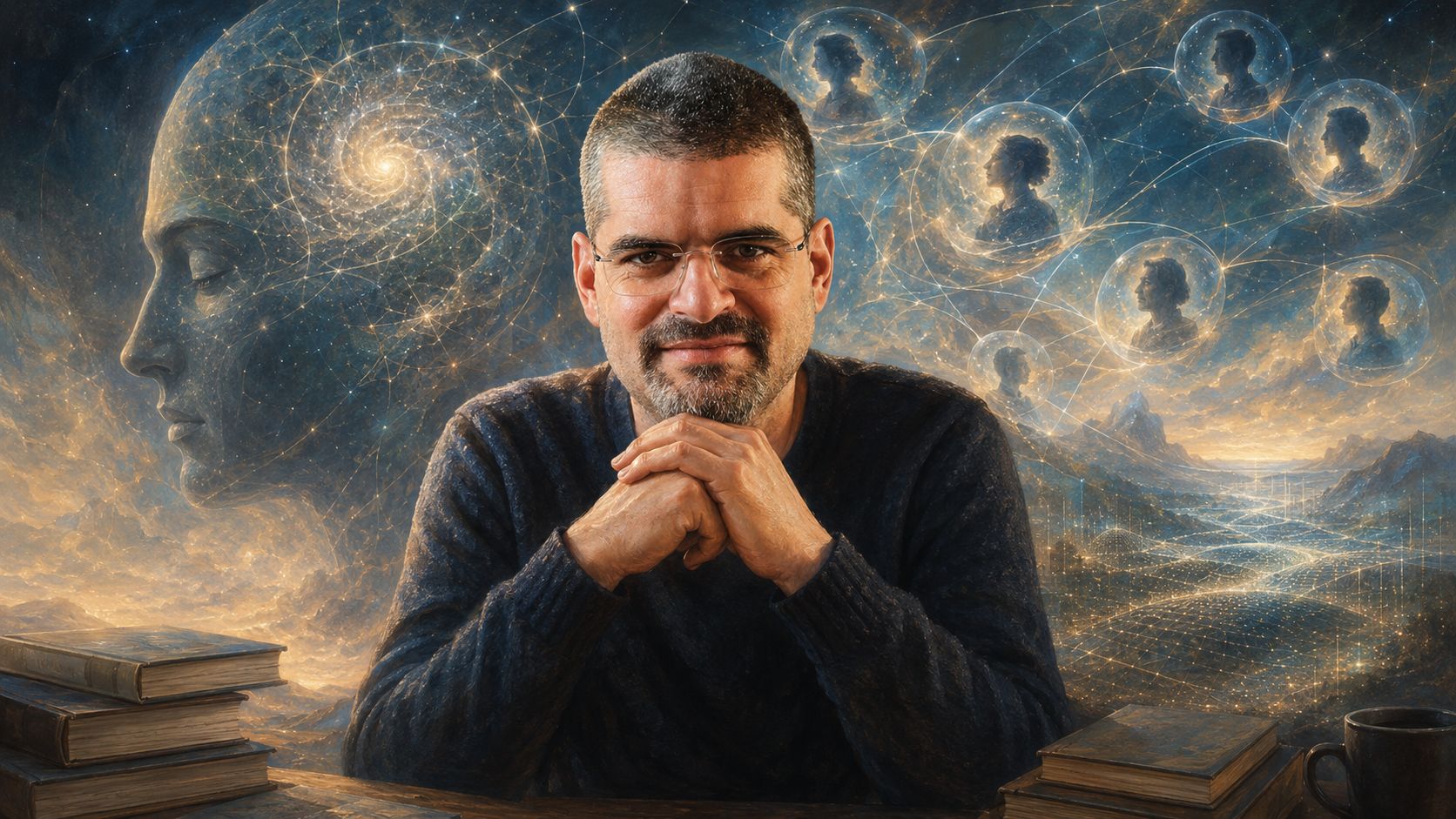
When we dream at night, the mind builds a whole world. A landscape, people, their faces and voices. Those figures feel like strangers. We speak with them, they surprise us, sometimes they move us. And yet the whole world is woven from a single mind. From ours.
Bernardo Kastrup argues that the whole of reality works this way. Reality is consciousness. And consciousness is one. Everything that exists is movement within one vast mind. We, stones, stars, and our bodies. Each of us sits in that mind like a whirlpool in a river. A whirlpool is water turning in one place. It looks like a thing of its own, yet it is only a shape the water has taken for a while. In the same way we are shapes of one consciousness.
It sounds like poetry. Yet Kastrup argues for it with the strict tools of philosophy, leaning on physics and on psychiatry.
Why matter cannot explain experience
Today’s science mostly holds that matter comes first. Tiny fundamental particles carry properties such as mass and charge. From them assemble atoms, molecules, cells, the brain. And once the brain grows complex enough, consciousness is said to appear. This view is called physicalism, or materialism.
Here is the crack. Nothing in mass or in charge tells us what it is like to feel warmth or to see red. We can know every detail about the motion of particles in the brain and it still will not tell us why anything is experienced at all. The philosopher David Chalmers named this the hard problem of consciousness. Between dead matter and living experience yawns a gap that no one has bridged.
The philosopher Greg Rosenberg added a finer point. Science describes each thing only by how it differs from other things. We know a positive charge by how it behaves toward a negative one. It is all relations and differences, nowhere any inner content. Experience runs the other way. When we see yellow and red, first we have the colours, and only out of them arise the differences between them. Matter rests on differences without content. Experience rests on content from which differences follow. One will not build the other.
A spark in every particle is not enough
Some philosophers tried to step around this. They said a spark of consciousness already sits in every particle. This view is called panpsychism. Then consciousness need not be manufactured out of anything. But a new problem appears. If every particle has its own small flash of experience, how do billions of these flashes become the one experience now reading this sentence?
The philosopher Sam Coleman showed why it cannot work. Imagine one tiny mind that sees only red, and another that sees only blue. Join them. What happens to those two points of view? At least one must vanish. If a view of purple appears, both have vanished. In water, hydrogen and oxygen still remain. Points of view do not remain once joined. You cannot assemble one large mind out of small ones. Philosophers call this the combination problem.
One universe, one subject
So let us try the reverse. Let us begin with the whole. Perhaps the entire universe is a single conscious subject. Physics gives this a surprising hand. Quantum entangled particles behave as one indivisible whole, and according to John von Neumann they entangle into a larger system at every interaction. The lifeless universe thus forms one indivisible web. This view is called cosmopsychism.
Now the question turns over. If at the start there is one great mind, how do separate private minds arise within it? Why can we not read each other’s thoughts when we are both part of the same mind? This is the decomposition problem, and it is the one Kastrup has to solve.
The solution from the psychiatrist’s office
The solution came to him from psychiatry. The mind already knows how to divide itself. We see it in dissociation. In its strongest form, dissociative identity disorder, several separate personalities arise within one person. Each has its own memories and its own inner world, and often does not even know of the others. These personalities are called alters.
Kastrup’s idea fits into one sentence. Every living being is such an alter of one cosmic mind. Dissociation creates a boundary in the mind, and behind it a private space. That very boundary is what closes your inner world to me.
And this is not only a pretty image. Doctors described a woman with dissociative identity disorder, one of whose personalities was blind. When that personality took control, the parts of the brain responsible for sight went quiet, although her eyes were open. When the seeing personality returned, the brain saw again. Another study compared the brain scans of real patients with scans of actors who only mimicked the disorder. The scans differed. Dissociation leaves a visible trace in the body.
His own position has a name. Kastrup calls it analytic idealism.
Experience is movement
Cosmic consciousness is constant. Experiences come and go. How do we join the two? Kastrup says experiences are the waving of this consciousness, its own trembling. A dance is the dancer in motion. Once we have the dancer and the motion, there is nothing left to add. Experience is such a motion of consciousness. Physics too now sees particles as the vibration of a field, and Kastrup carries the same image over to consciousness.
Why the world looks like matter
The hardest question remains. If everything is mind, why does perception differ so much from thought? A thought is misty and private. A table is hard, and anyone can check this for themselves.
Kastrup answers with the story of the first boundary. Before the first alter arose, the cosmic mind held only thoughts. Perception did not yet exist. The boundary changed that. The thoughts surrounding an alter press on its boundary from outside. The alter feels that pressure as perception. The material world is the face of a cosmic thought seen from the other side of the boundary.
What we see and hear does not copy those surrounding thoughts faithfully. It only labels them. Donald Hoffman likens this to the icons on a computer screen. We see a file on the screen as a blue rectangle. In truth the file itself is neither blue nor a rectangle. The icon only makes it easier for us to handle something we could not otherwise grasp. Evolution tuned our senses so that we would survive. It cared little for truth. Karl Friston showed this in mathematics as well. A being that mirrored the world with full precision would fall apart into chaos. To survive, it must compress the world into simple marks. That is why perception looks unlike what it represents.
The brain again, in reverse
Here the strongest argument of materialism turns inside out. Brain states accompany our experiences. The materialist concludes that consciousness is a product of the brain. Kastrup understands the same fact the other way. The living body is how the inner life of an alter looks from outside. Brain activity is the visible face of an inner process, just as the blindness of that woman was the visible face of her dissociation. What goes on in the body without our conscious experience, the work of the liver for instance, answers to contents of the mind that our speaking self has no access to.
One shared world
The last question. If I picture the world to myself, why do we all meet in the same world, and why does it not obey my wishes? Because the alters float in one sea of cosmic thoughts like islands. The same surrounding thoughts press on the boundary of each of us and produce a matching image. And my will is only one more content in my own small corner of the mind. It has no power to rewrite the laws by which the whole sea behaves. That is why the world from outside feels solid and independent.
Why this is worth attention
Kastrup offers a world in which consciousness is first and matter is its outer face. He does it soberly, systematically. For anyone who senses a deeper order behind the visible world, this is familiar ground. One mind expresses itself as a whole living world. Every being becomes a window through which the whole looks at itself. Healing then touches that hidden order behind the body. Kastrup does not take this last step. He lays the firm ground on which we can build further.
Original academic text: Journal of Consciousness Studies 25 (5–6), 2018, pp. 125–155.
https://philarchive.org/rec/KASTUI

