

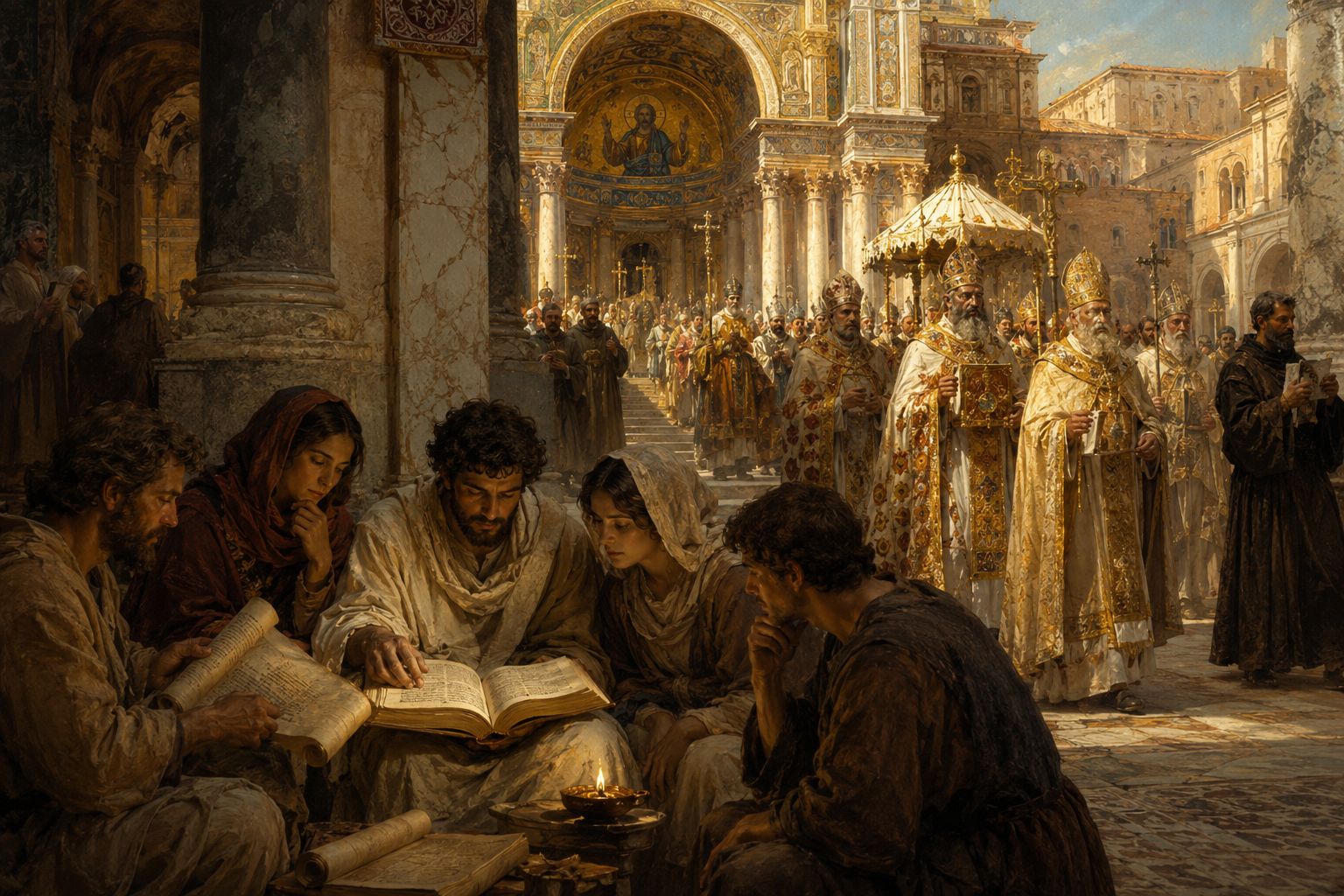
When Constantine granted Christianity legal recognition in 313, the Gnostics were already in decline. The great Gnostic schools had reached their peak roughly a century earlier. The question of why they almost disappeared from history is often answered too superficially, as if the victors simply had the better theology. The real cause was more prosaic. The Gnostics failed to build a lasting organization capable of carrying their ideas from one generation to the next. Their opponents did. That made the difference.
Who Were the Gnostics?
Under this single name we find a diverse group of teachers and communities of the second century. Valentinus, Basilides, the Sethian groups, and others differed in many details, yet they shared a common core. Salvation comes through gnosis, through knowledge. A person does not attain it by accepting an external doctrine, but through an inner experience of his or her true nature. Many taught that the material world was created by a lower god, the demiurge, and that a spark of the true divine is imprisoned within the human being. The aim of life is to awaken this spark and return it to its source.
Their attitude to authority grew out of this core conviction. If salvation depends on personal knowledge, the priest as mediator between the human being and God loses his necessity. The Gnostics therefore rejected a fixed hierarchy standing between the believer and the divine. Tertullian complained that among them it was not clear who was a layperson and who was a priest. Roles changed. One person might preside over the service today and another tomorrow. Women also taught. Almost anyone could baptize. For a Gnostic, this was fidelity to the principle of equal access to knowledge. For their critics, it was chaos.
Structural Weakness
Here their vulnerability began. A tradition built on personal illumination and changing roles is difficult to reproduce on a large scale and over time. A charismatic teacher gathers disciples, but after his death the teaching splits into variations. Without a stable office, without a binding text, and without a shared creed, each community follows its own path. A group of this kind cannot create a united front or negotiate with power as a single body.
The sociologist Max Weber later described this transition as the routinization of charisma. The original religious impulse comes through an exceptional individual and his direct experience. If it is to survive longer than its bearer, it must be transformed into an institution with rules, offices, and succession. The Gnostics resisted this step because it contradicted their conviction about direct knowledge. Orthodox Christianity carried it out with consistency.
How Orthodoxy Built Its Institutions
The struggle took place before Emperor Constantine the Great came to the throne. In the second and third centuries, the defenders of the emerging orthodoxy created a set of instruments the Gnostics lacked. The bishop, with a clearly defined office, governed the community and led it in one direction. Apostolic succession claimed that the right to teach was transmitted in an unbroken line from the apostles, giving bishops a legitimacy the Gnostic teacher did not possess. Rules of faith, short common professions of belief, defined what belonged to the teaching and what did not.
The decisive step was the canon. When Marcion, in the middle of the second century, compiled his own narrow selection of writings and rejected the Old Testament, he forced the others to respond. The Church began to define which gospels and letters counted as authentic. In this way, a closed list of texts emerged, one that could be invoked against every new teaching. Around the year 180, Irenaeus of Lyons wrote a large work against the Gnostics, in which he presented and refuted their systems. From today’s perspective, what matters is that the categories of true faith and heresy were formed precisely in this conflict. The historian Walter Bauer showed that early Christianity was far more diverse than later tradition admitted, and that what prevailed was later declared to have been original.
The nature of the message also played its part. Orthodox Christianity offered salvation to everyone, to the educated and the simple alike, without the need for initiation into secret knowledge. Gnosis remained the concern of a narrower circle of people capable of deeper contemplation. A universal and accessible message spreads more easily than a teaching for the chosen few.
Constantine and Imperial Support
Constantine faced an empire torn by tensions and looked for forces that could hold it together. An organized Church with bishops, a network of communities, and internal discipline represented such a force. His support did not arise only from cold calculation. He had a personal interest in the faith and intervened in Church disputes himself. For the state, however, the usefulness of the Church was decisive. Scattered Gnostic groups without a common structure could not offer what the organized Church could offer: a unified support for the unity of the empire.
The Council of Nicaea in 325 showed how this mechanism worked. Its main subject was not the Gnostics, but Arianism, the dispute over whether the Son is equal to God or was created by Him. Constantine summoned the bishops in order to settle the dispute and make the Church speak with one voice. The result was the Nicene Creed, a common formula binding on all. The important point is the procedure itself. Emperor and bishops together drew the boundary between the acceptable and the unacceptable and gave it the force of law. The same ability to define binding doctrine, which had once pushed the Gnostics aside, now resolved the internal conflicts of orthodoxy.
Theodosius and State Religion
The process was completed by Theodosius. The Edict of Thessalonica in 380 declared valid only the Christianity professed by the Roman bishop Damasus and the Alexandrian bishop Peter, that is, the Nicene faith in the Trinity. The Second Council of Constantinople in 381 confirmed and expanded this confession. Whoever stood outside it ceased to be recognized. The Gnostic branches that had survived on the margins lost their last remaining space. After the fourth century, the traces of gnosis were confined to remote parts of the empire and to the Arabian Peninsula.
What We Almost Lost
For a long time, we knew the Gnostics almost exclusively through the writings of their opponents. This changed in 1945, when a collection of Coptic writings was discovered in Nag Hammadi, Egypt. The Gospel of Thomas, the Gospel of Philip, the Secret Book of John, and other Gnostic texts allowed these traditions to speak in their own voice. On the basis of these writings, the scholar Elaine Pagels showed that the conflict between Gnostics and orthodoxy was not only about theology. It was also about social order, about who had the right to teach and decide within the community. The hierarchical structure of orthodoxy was one of the main reasons for its survival.
The Second Life of Dualism
The idea of two principles, good and evil, material and spiritual, returned centuries later. In the tenth century, the Bogomils were active in Bulgaria, a dualist current with roots reaching back to the Paulicians of Armenia and Anatolia. From the Balkans, this teaching reached Western Europe. In the twelfth and thirteenth centuries, the teaching of the Cathars spread in Languedoc in southern France, and partly also in northern Italy and Spain.
A direct line from the ancient Gnostics to the Bogomils and Cathars remains disputed among historians. Older works saw an unbroken chain of transmission of dualism. More recent research points out that the image of Catharism as an organized society rejecting the orthodox Church may also have been shaped by inquisitors and Catholic polemicists, who merged different forms of dissent into a single heresy. What is certain, however, is that among the Cathars we find dualism and resistance to a wealthy and powerful Church.
Unlike the ancient Gnostics, the Cathars built their own structure. They had their Perfects, the so-called bons hommes, who lived ascetically and formed a distinct spiritual layer. This organization made them a real rival, an organized alternative to the Roman Church. For that reason, the Church, allied with the French crown, acted against them by force. The Albigensian Crusade from 1209 to 1229, followed by the Inquisition, crushed the Cathars.
What Follows from This
The story of the Gnostics and the Cathars shows two sides of the same thing. Organization decides whether an idea survives. The ancient Gnostics rejected it and dissolved after a few generations. Orthodoxy built it, survived, and became a support of the empire. When, however, a current becomes organized enough to threaten the ruling institution, as happened with the Cathars, that same institution responds with violence. Organization therefore protects an idea from oblivion, while at the same time making it a visible target.
Behind this mechanism lies a more general question about the nature of knowledge and power. The Gnostics believed that truth is directly accessible to each person, in one’s own experience, without a mediator. This position is liberating and fragile at the same time. It frees the human being from dependence on authority, while making common action and defense more difficult. History has so far shown that durability belongs to organized forms.
The Same Conflict Today
The conflict between direct knowledge and organized authority did not end in the fourth century. It returns whenever a new experience stands against an established institution. Today it appears in the dispute over the place of consciousness in our interpretation of the world. The dominant interpretation is scientific materialism, supported by a powerful organization. It has its universities, peer-reviewed journals, grants, and expert control of access. It has its canon of textbooks and its confession of faith, according to which consciousness is only a by-product of matter. Behind this structure stands the same institutional power that once stood behind the orthodox Church.
Against it we hear voices that place consciousness first: analytic idealism, panpsychism, research into extraordinary states, contemplative traditions. These voices find themselves in a position similar to that of the ancient Gnostics. They are based on direct experience and inner knowledge. They are scattered, connected to individual teachers, and weakly linked to one another. From the point of view of the ruling institution, they remain beyond the boundary of seriousness.
The historical lesson is clear. A scattered current based on direct experience will not defeat organized authority by itself. If a new understanding of consciousness is to survive and spread, it faces the same task that orthodoxy once accomplished. It must create lasting forms capable of carrying it forward, and do so without losing its essence: openness to direct experience.
One thing has changed since the second century. The Gnostics failed partly because they could not connect and coordinate with one another across distance. Today’s networks make this possible even without a fixed hierarchy. An idea can spread and bring people together across countries without a bishop at the top. This changes the old equation. Direct knowledge no longer has to accept a rigid hierarchy of power in order to survive. It can seek a form that holds together while remaining open.
The Consequence for Consciousness
Beneath the conflict over organization lies a deeper question: what do we consider knowledge at all? The Gnostics claimed that the most important truth is accessible within, in the direct experience of one’s own nature. Orthodoxy established another model. Truth comes from outside, through binding doctrine mediated by authority. The victory of the second model had far-reaching consequences. Because of it, European thought has tended to seek certainty outside the human being: in text, in office, in measurement, in data. Materialism is the heir of this attitude. It recognizes as real what is outside, measurable, and verified by an institution.
In the development of consciousness in our time, we encounter precisely this inherited trace. If we want to restore consciousness to its proper place in our image of the world, we must once again recognize inner experience as a source of knowledge that complements the external method. Contemplative traditions have examined the experience of consciousness for centuries and offer material that the laboratory cannot create by itself. To join the discipline of the external method with the recognition of the importance of inner experience is a task no one before us has fully solved.
This is the lesson of the whole story. Pure individualism of knowledge, where everyone has a private truth without a shared foundation, leads to fragmentation and loneliness. An institution without the living core of experience turns into an empty rite. The Gnostics and the Church each held a part of the truth, and each partly lost it. Our task is different. We need to find a form that can accept both approaches, firm enough for transmission and open enough to remain alive.
The question remains whether we can build communities around a new understanding of consciousness in such a way that they preserve the strength of organization without repeating its oldest mistake: turning living knowledge into a closed doctrine that excludes everything else.