
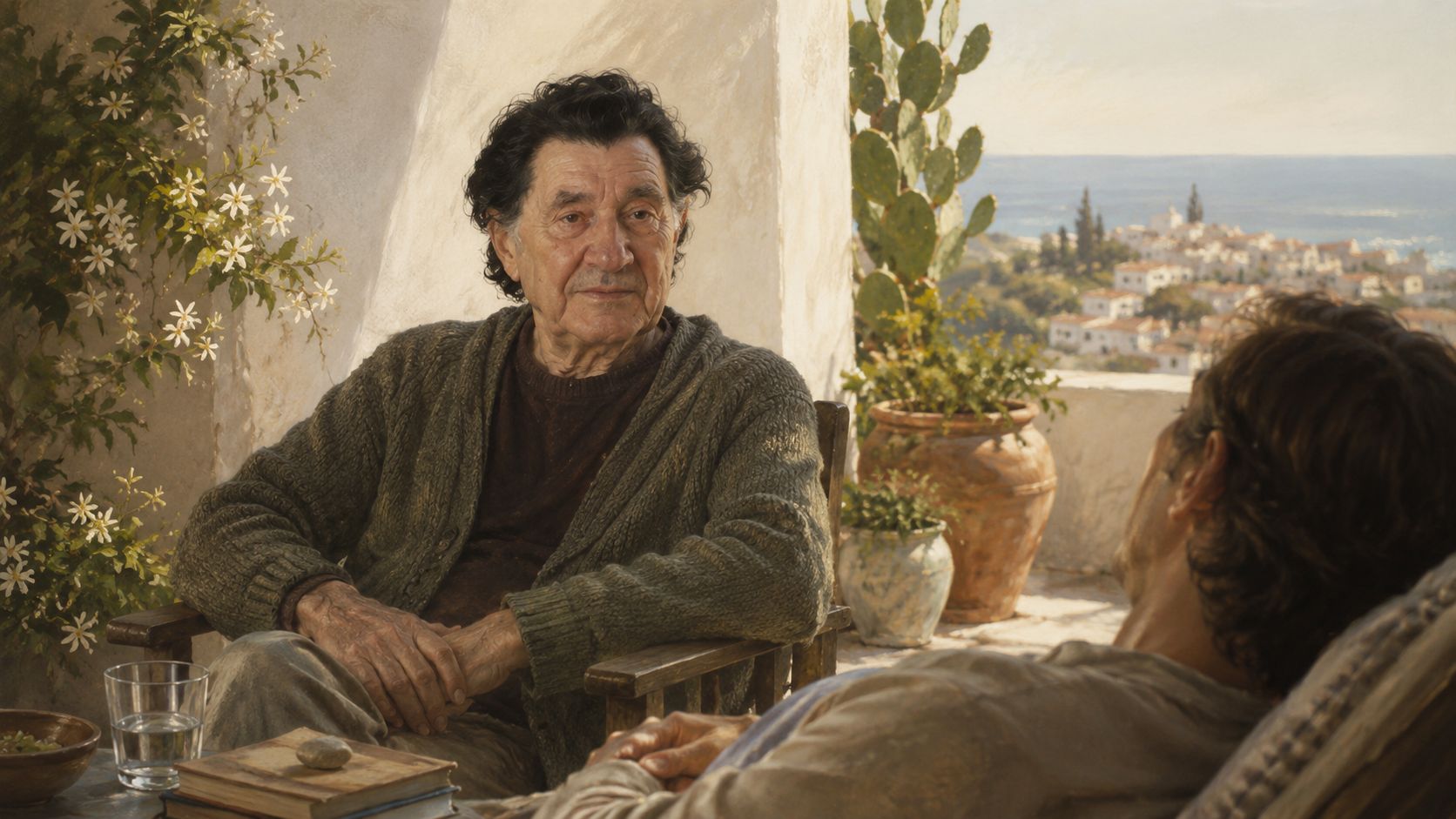
One scene in Kyriacos Markides’s Fire in the Heart says more to healers than whole chapters of theory. Daskalos, the Cypriot healer and mystic, sits with his student Stephanos. Stephanos is confused. People come to him and say he healed them, yet he has no idea how. During meditation he felt a force that placed him in front of a woman with severe arthritis. Without thinking he touched the place where she felt pain, and the pain went away. He describes himself as a cable through which healing energy passes to the other person.
Daskalos answers with a sentence that turns the whole situation around. Stephanos does not heal. His inner self heals. Stephanos is only the temporary shadow of the real actor, the costume that the ego-self put on for this life. For those of us who work with healing, this idea is far closer to our experience than it first appears.
Who Is the One Who Acts
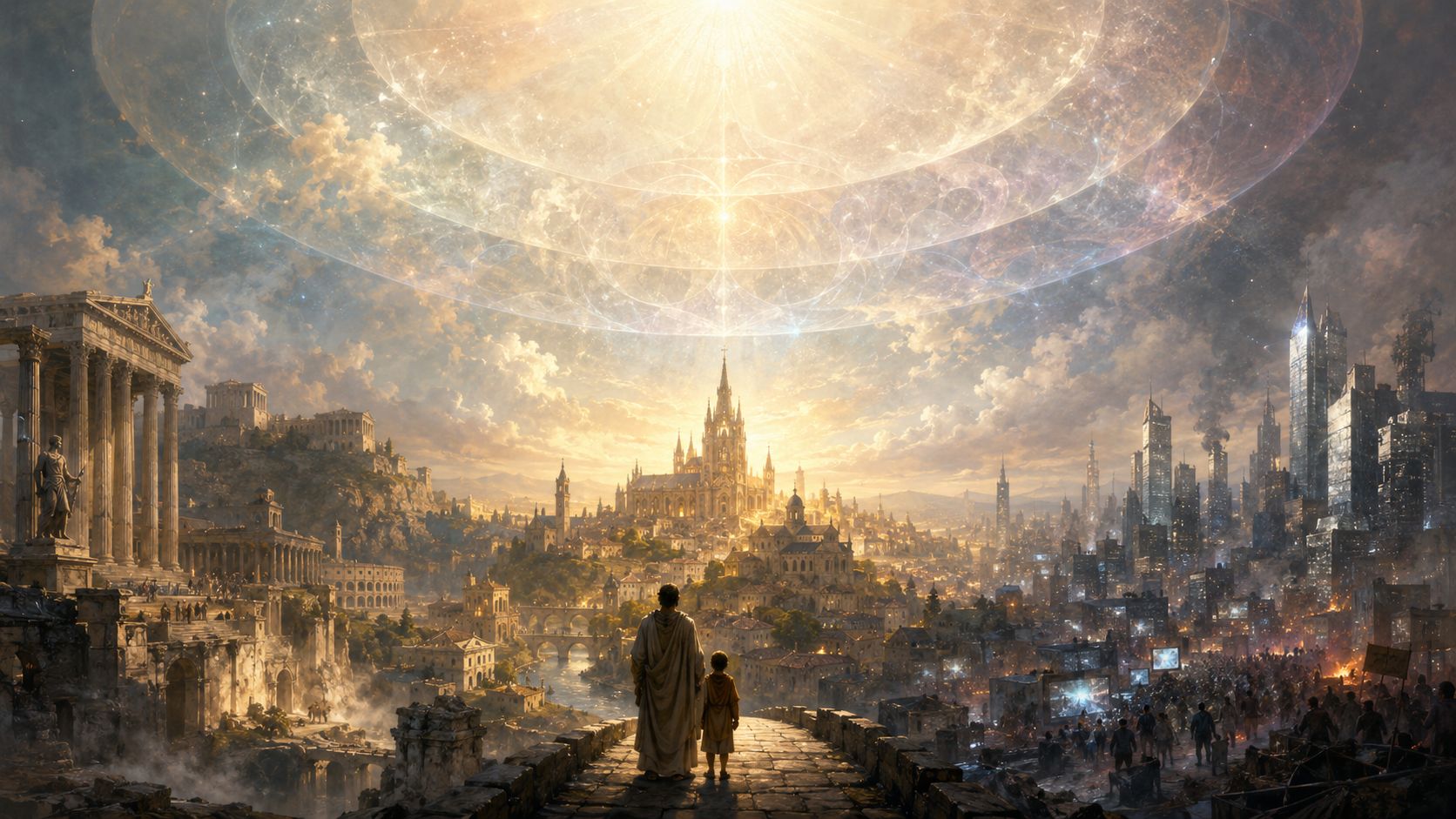
Daskalos’s image of the human being has several layers. The present personality is made of three bodies. The gross material body lives in our space. The psychic body carries feelings and its center is the heart chakra. The noetic body is the body of thoughts, with its center in the head. These three bodies are what we usually take to be our self.
Beneath them lies a more permanent layer. The deepest is the Pneuma, the Spirit-ego, that part of the human being which is qualitatively identical with the Absolute, which never came into being and never dies. The Pneuma descends into the world of polarity to gain experience and to develop its uniqueness within the oneness. When Daskalos says that the inner self heals, he means this layer. The one who acts is the deeper self, and the personality with its name and biography is its expression.
The Healer as a Conductor
From this follows Daskalos’s understanding of healing. The healer is a conductor of the force, not its source. The condition is not technique or the will to impose an outcome, but a sincere wish to serve. Stephanos says that in that moment he seemed to receive a command to heal. Daskalos corrects him. The command does not come from outside. Your inner ego acts because you wish it.
Every homeopath knows this from good consultations. The best work tends to be the work in which the therapist’s ego steps back and attention shifts to the patient and to the image that wants to appear. We do not try to force the outcome. We create the conditions in which it can emerge. Daskalos gives this experience a metaphysical frame. The healing force does not originate in us. It passes through us.
Elementals and the Psychonoetic Body
The second idea a Quintessence Forum reader will value is Daskalos’s understanding of thoughts and feelings. He does not treat them as passing states in the head, but as real structures, which he calls elementals. Every thought and every feeling creates a form with its own lifespan. This form acts back on its creator and on the surroundings. A person lives surrounded by what he thinks and feels over time.
The concept of the psychonoetic body grows from this. At the first incarnation an amorphous mass of energy appears around the heart chakra. Through repeated lives this mass, woven from thoughts and emotions, takes on the shape of the material body and becomes more radiant. The degree to which it is formed corresponds to the person’s spiritual maturity.
Here Daskalos’s model touches our craft. If mental, general and physical symptoms all arise from one structure, then their unity in the image of the remedy is not a methodological convention. It follows from how the human being is built. What the patient thinks and feels, and how the state shows up in the body, belong to one layer. When we look for the image of the remedy, we do not combine three separate domains. We read one expression on three levels.
The Erevna as a Discipline of Experience
The community Daskalos led called itself the Researchers of Truth. The Greek word Erevna means research. It was not belief in ready-made dogmas, but a practical discipline meant to bring a person to direct experience of higher levels of consciousness. Knowledge here is not handed over as a set of claims to accept. It is acquired through one’s own work and verified by one’s own experience.
This is close to what we aim at on Quintessence Forum. A shift in worldview will not come from accepting a new list of truths. It comes when we change the way we know. Daskalos’s school is an example of a tradition that put experience and practice before the authority of the text.
Everything Is Mind
Behind the whole book stands one sentence. Mind is the substance from which all dimensions of existence are woven. On this view matter is not the ground of the world, but one of its expressions. Daskalos reached this conclusion through experience rather than through argument.
This is where his tradition meets contemporary philosophy of mind. The idealism to which part of today’s debate is returning says the same thing in another language. If consciousness is primary and matter derived, then the inner world is not a weaker version of the physical world, but its foundation. For a healer this has a direct consequence. Working with the mental and emotional level of the patient is not working on a layer built on top of the body. It is working with the ground from which the body arises.
Theosis and Service
The model has its developmental arc. Karma is the law of cause and effect, reincarnation is a means of learning, and the goal is Theosis, union with the Absolute while keeping one’s uniqueness. The book records a detail worth noting. Great masters who reach the threshold of Theosis and could enter often postpone it, because they want to stay and help others. The higher a person ascends, the greater the love and compassion, and the greater the readiness to serve.
This is the ethical core of the whole tradition, and it gives meaning to our work. Healing and the growth of consciousness are not ends in themselves. They are preparation for service. Whoever grows, grows in order to give more.
Why It Matters for Us
Fire in the Heart is not a textbook, and its claims cannot be taken as established fact. It is a portrait of a living mystical tradition, seen through the eyes of a sociologist who neither surrendered to it nor accepted it uncritically. For a healer several things in it are worth thinking through. That the one who heals is the deeper self, not the temporary personality. That the healer is a conductor, not a source, and the condition is the wish to serve. That thoughts and feelings are real structures which shape the person on all levels at once. And that working with the patient’s inner world is working with the ground, not with something added on top.