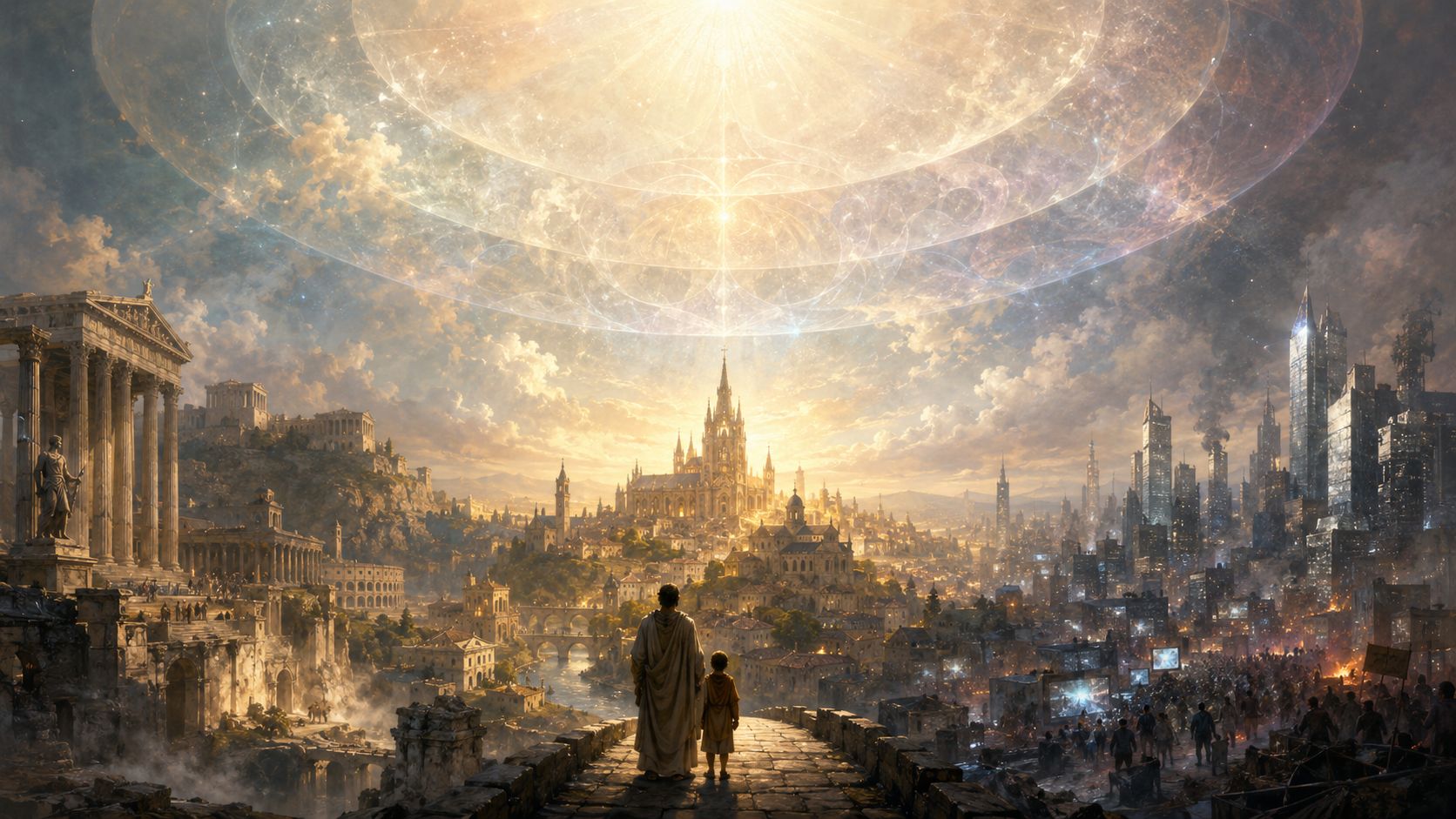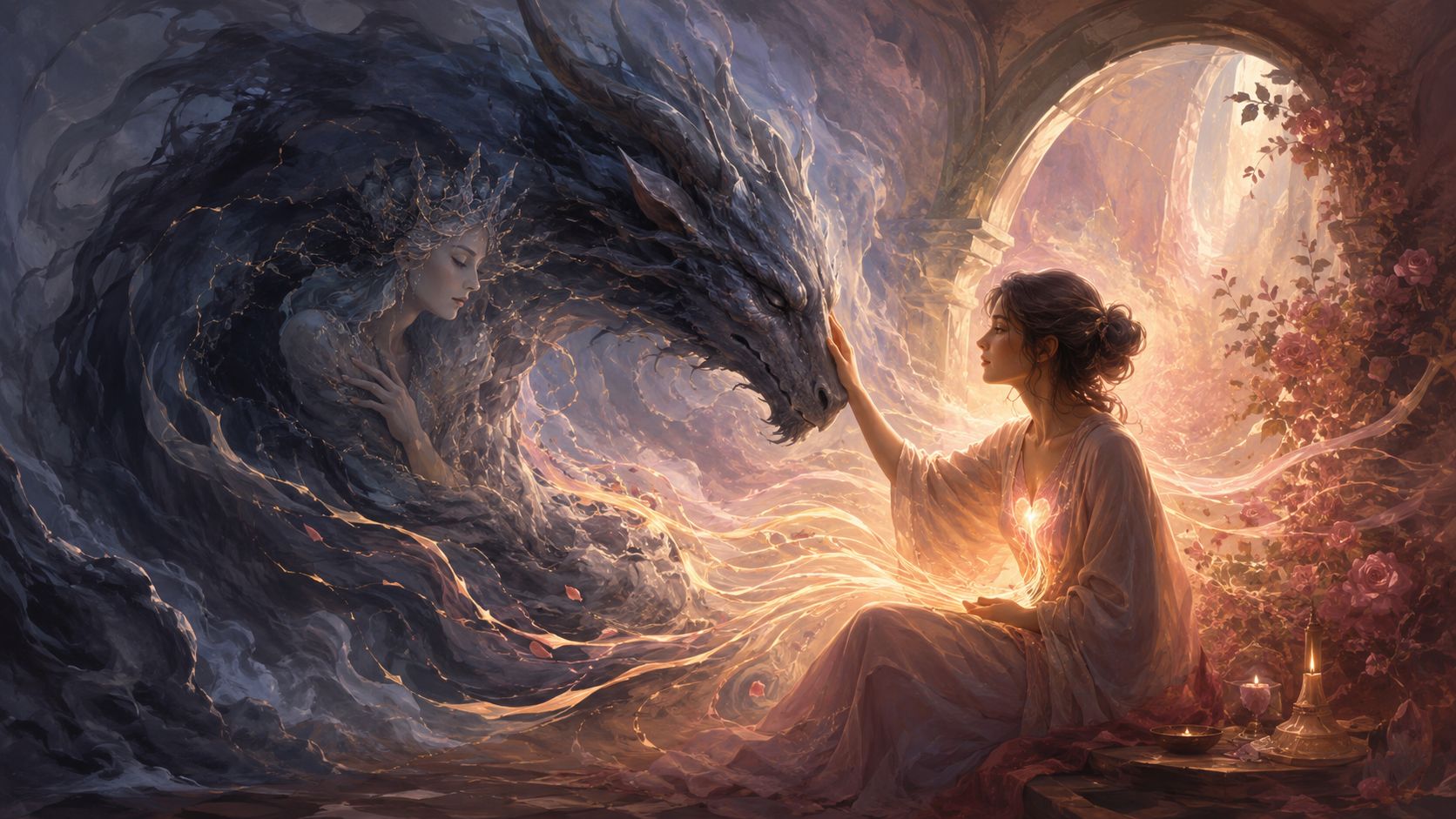


J. R. R. Tolkien is known as the author of The Hobbit and The Lord of the Rings. Fewer people know that behind these famous books he created an entire mythology, a history of this world from its creation to its end. Tolkien was a deeply devout Catholic and, at the same time, a scholar of northern languages. His mythology has a carefully thought-out theology. Its stories were published in The Silmarillion, which his son Christopher edited and brought out after his father’s death. It also contains an eschatology, a teaching about the last things. A story of how the world will end.
Tolkien’s world came into being through music. At the beginning stands Eru Ilúvatar, the One, God, and the Ainur, the Holy Ones, angelic beings who came forth from him. The greatest among those who enter the world are called the Valar, and the lesser ones the Maiar. Eru gives them a theme, and the Ainur develop it through song. From this music the world arises: Arda, and its central landmass, Middle-earth.
Let us notice how this happens. At first, the music is not yet the world. It is a vision of the world. Eru shows the Ainur the image of what they have sung: beautiful, yet not yet real. Then he speaks a single word, Eä, let it be, and sends into the void the Flame Imperishable, the secret fire that gives being. Only then does the vision become reality, and the song takes form in matter.
But discord enters the music. Melkor, the greatest of the Ainur, later called Morgoth, weaves his own motifs into the song. He wants to enlarge his own part. He wants to be the source himself. Eru does not erase this discord. He tells Melkor that whatever he may play, he will discover that its deepest source lies in Eru, and that his rebellion, against his own intention, will become part of a beauty he did not foresee. The world is wounded. It carries trauma. Tolkien has a term for this: Arda Marred, the wounded Arda. The wound is real. And its healing is real as well.

I will briefly turn to the way I myself look at reality, because Tolkien’s myth almost perfectly meets it. I see reality as four levels of one and the same thing. Everything proceeds from pure Consciousness, from the source that the Kabbalah calls Ain Sof. That is Eru. Above it is the layer of archetypes, of the highest spiritual beings. These are the Ainur and the Valar. From that layer sounds the third, resonant layer, the layer of vibrations, energies, and music. That is the Great Music. And from it, finally, arises the fourth layer: the material world that we perceive with our senses. That is Middle-earth.
Whether we call this path a descent or a building-up depends on our point of view. Tolkien and the Kabbalah read it from above downward, as an emanation from the source. I am closer to an image in which the source is the foundation that carries everything, and the world grows upward from it and thickens into matter. In either case, matter is the final, outer form of something that began as pure consciousness and passed through archetypes and vibration, through music.
Melkor’s discord did not strike finished matter. It entered the third, resonant layer, the creative song. That is why Arda is not marred only on the surface. The wound is deeper and reaches into the foundation. It lies in the very song from which the world arises.
This also touches the question of where evil comes from. Melkor is not an equal counter-god. He is a created being, the greatest of the angelic beings, but he is marked by pride. In Tolkien, evil has no substance of its own. It is the corruption of something originally good. Morgoth cannot create. He can only mutilate and mockingly imitate.
Tolkien also has a precise understanding of death. In his world, the Elves are bound to Arda. After death they do not depart from it, but remain within the sphere of the world and share its fate. Human beings have another destiny. Tolkien sees mortality as the gift of Ilúvatar. After death, a human being leaves the world completely, passes beyond its boundaries, and goes to Eru, where even the angelic powers cannot see. Death appears to be a curse because Melkor’s lies made it appear so. In truth, it is a gift. Something that looks dark when seen from close up is, in reality, a gift.
What comes at the end? Tolkien calls it Dagor Dagorath, the Battle of Battles. It is the final battle. Melkor breaks free from his bonds, returns, and all the powers of good meet all the powers of evil. In this battle, Arda is destroyed. This ending comes from Tolkien’s manuscripts. Christopher did not include it in the published Silmarillion, and it appeared later elsewhere. As a Tolkienian idea, however, it is genuine. What matters is that the story does not end there.

After the destruction of the world, the Second Music is to come. The First Music was sung by the Ainur alone. The Children of Ilúvatar, Elves and Men, merely entered an already made world. After the end, the Second Music is to sound, and in it the Children too will sing, especially human beings, alongside the angelic beings. This music will be greater than the first.
We are now inside a song we did not compose. Our destiny is to become singers. What makes us beings capable of singing the Second Music is precisely the path we have passed through. Wounding, struggle, death. One who has remained untouched could not do it.
And we do not have to wait for the end of the world. The Second Music is already being prepared now, in each of us. Whenever we place a clear voice, a fragment of truth or beauty into the world, we tune ourselves to the original theme and bring light to the place where we stand. That is our part in the song. Small, yet real.
There is much wisdom in this myth. It says that the world is wounded, and there is no need to pretend otherwise. It says that evil is real and must truly be faced. At the same time, it says that evil is not the world’s substance and will not have the last word. Catastrophe becomes a threshold of transformation. The renewed world is something greater than the original beginning, precisely because of all the experience and suffering that help us evolve. We are not merely spectators. We are those who are becoming singers in the choir.
The fire of Fatima and the Battle of Battles are saying, in essence, the same thing. Warning and catastrophe are serious because what is at stake is real, and because love is real. Both stories end in the same way. Not with the annihilation of the world, but with a world created anew, and with an invitation to enter into its creation.
A myth such as this is a way of accepting reality and our shared responsibility for it. Tolkien called his own creative work sub-creation. By this he meant the following: God creates reality, and the human being, created in his image, is also a creator. He cannot create real things in the full sense, but he can create worlds in imagination, myths and stories. Tolkien saw this as a sacred activity, not an escape. He believed that a story formed in this way can bear truth. I offer it to you in that spirit.