

The old cultures did not pass on their deepest knowledge of the world as theory. They placed it into stories of gods and heroes, of how the world began and how it ends, because they knew that an image and a story reach deeper than a definition. A myth shows us how the world is ordered, and it does so by drawing us into the action. When we identify with the story, we sink into its truth along with it. Our age has lost a great part of these living myths. The old tongue has grown faint. Science gives us facts. It does not give us an image in which the world would have meaning. This is exactly why our age needs a new myth, a story that can carry truth and in which we could at the same time live.
The six books of Earthsea by the American writer Ursula K. Le Guin are gripping stories, with an island world, with a young wizard named Ged and with the flight of dragons over the sea, stories that pull you in and will not let go. And they are wise books at the same time, because behind their story lies one of the most finely worked images of the world that fiction has ever produced. Le Guin was the daughter of anthropologists and was shaped all her life by Taoism, and she later even made her own rendering of the Tao Te Ching. From all this she wove a world that works as a true myth. It is worth getting to know that world, because it speaks of things that concern everyone. Of power, of language, of death, and of what holds the world together.
The World as Balance
In Earthsea everything is connected with everything. The world is one great, finely balanced whole, and every act ripples on through it, the way a stone sends rings across still water. The mages of that world know this, and so they are careful. The true mage is not the one who works the most magic. He is the one who knows when to leave things be and not to intervene. The young and ambitious wizard wants to act, wants to show his power. The mature wizard knows that true wisdom is not to intervene needlessly. This is a direct echo of Taoism, the Chinese wisdom of the way and of non-doing, which is not laziness. It is action so attuned to the natural flow of things that it no longer even looks like action. The oldest song of Earthsea rests on the idea that opposites give birth to one another. Light and dark, life and death are not enemies. Neither exists without the other.
The True Name and the Old Speech
The second pillar of that world is language. According to its mythology the world was made by a word. A being named Segoy spoke the first names and the islands rose from the sea. Everything that exists has its true name in what is called the Old Speech, the language of the making. In it lies the heart of all magic. To know the true name of a thing or a person is to have power over it. Whoever knows the true name of fire can call it. Whoever knows the true name of a hawk can call it down from the sky. The Old Speech is moreover a language in which one cannot lie, because in it the name and the thing merge into one. To speak the name is to touch the essence.

This is why the people of Earthsea guard their true names anxiously. In daily life they go by use-names that betray nothing. They entrust the true name only to someone they wholly trust, because whoever knows it holds their deepest essence in his hands. The world here is literally woven out of names. And to know the name is to know the truth of the thing. There is in this an old intuition that we find in many traditions. That the world is by its nature speech, and that to understand something is to know the word by which it was spoken.
Dragons and a Shared Origin
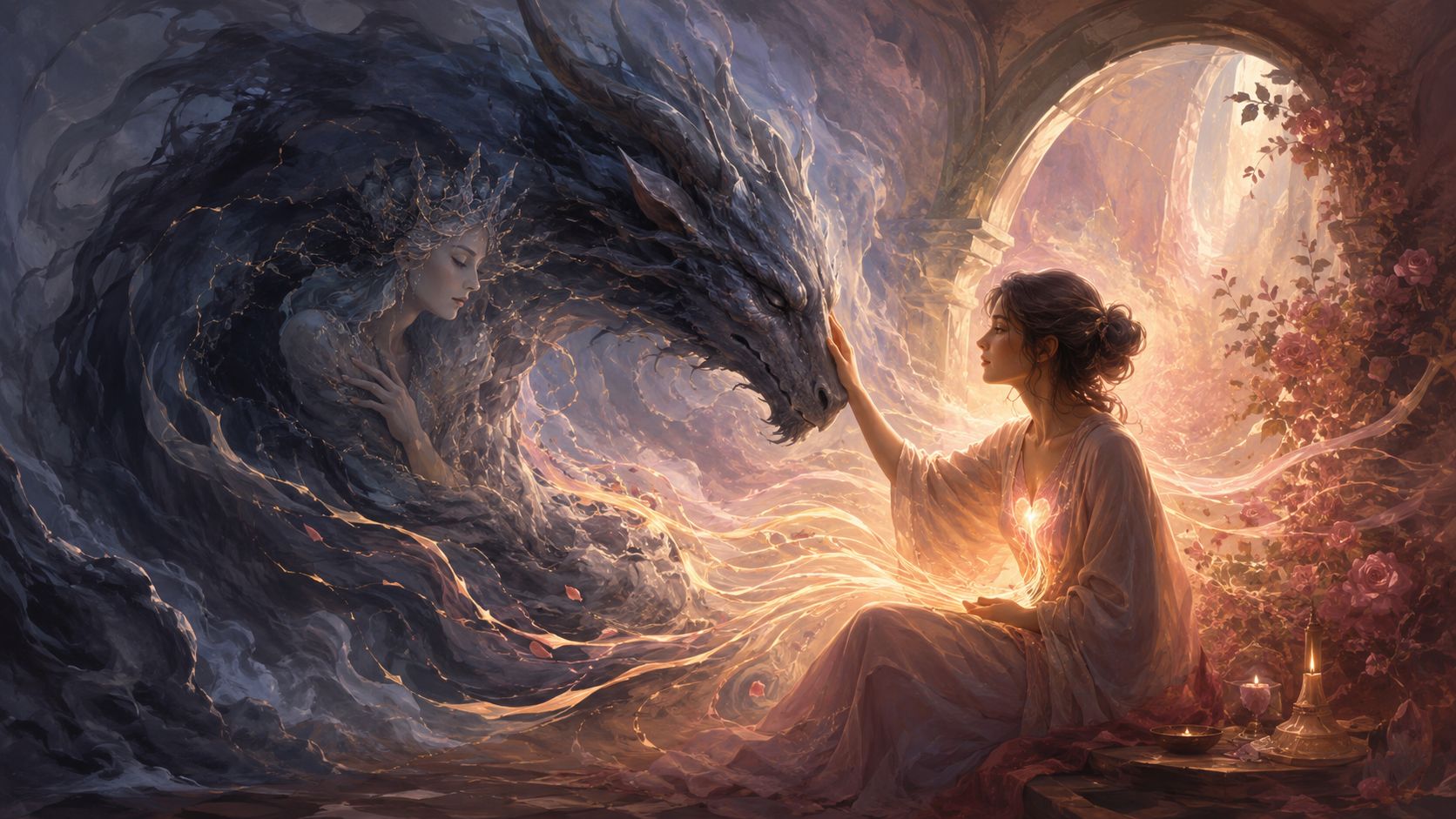
Dragons are the most striking beings in Earthsea, and they are also the key to its mythology. For a dragon the Old Speech is not a language he has learned. It is his mother tongue. The dragon and the word of the making are one, in a dragon there is no gap between what he says and what he is. Dragons and humans were once a single kind. In the beginning they were one and then they parted, because they did not long for the same things. Some loved freedom and the wild, the wind and the fire, and cared nothing for possession. From these came the dragons. Others loved making and knowledge, and held to things and to the land. From these came humans. The dragons kept the Old Speech and the wild freedom of the wind. Humans gained craft and property, and lost their unity with the creating word.
In this image the dragons are something like our older, wilder half. They are beings nearer the source, nearer that place where word and thing are not yet divided. When a dragon comes flying in the books, it is always an encounter with something ancient and free, with something that we humans once were as well and gave up in exchange for safety and possessions.
Death and the Wall
The strongest and darkest theme of the whole cycle is death. In the early books the dead go to what is called the dry land. It is a grey country behind a low stone wall, under stars that never move. There is only dust and stone there. The dead stand like shadows, without light and without love, and they do not know one another. It is a bleak picture of the beyond.
In the third book, called The Farthest Shore, an evil of a strange kind appears. A sorcerer named Cob is so afraid of death that he uses his power and breaks the wall between the living and the dead. He opens a hole in it, and through that hole meaning begins to drain out of the world. Mages forget their spells and their names, and whole lands are overcome by listlessness and despair. Cob promises immortality, yet for his craving to live forever the whole world pays, slowly drying out and losing its soul. It is an image of the ego that refuses to give up itself, and in that convulsive effort dissolves the whole around it.
In the last book, The Other Wind, a surprising truth comes to light. The dry land was not part of the world from the beginning. People made it by their magic long ago, when they decided to hold on to their own self after death, not to return and dissolve into the whole. The wall was no natural order of things. It was a prison that humankind built out of the longing to endure. The dead in the dry land were not at peace, they were imprisoned in their own frozen self. The healing of the world at the close lies in this, that the wall falls, the dry land melts away, and the dead are released at last and can return into the round of the world. They go back into the world, into the leaves, into the light, onto that other wind on which the dragons fly. True death here is no ending and no punishment. It is a return and a release, the acceptance that our small self is meant in the end to return into the great whole from which it came.
The Shadow That Bears Our Name
There is one more story worth recalling, because the depth psychology that grew out of the work of C. G. Jung speaks through it. In the first book, A Wizard of Earthsea, the young Ged out of pride and fear calls up a dark shadow, a nameless being that then tries to destroy him and pursues him across the whole world. Ged flees from it for a long time. He is healed only when he stops hiding, turns to face the shadow and addresses it. And he addresses it with his own name. The shadow was in fact himself, his rejected and denied part. To name it meant to take it back and to become a whole person. Carl Gustav Jung would say that Ged integrated his shadow. Le Guin made an adventure story out of it, yet it is an exact description of what happens in every mature human life. We become ourselves only when we accept that in us from which we have been fleeing.
Why This World Feels Close to Us
The world is made by a word and woven out of names. To understand something is to know its true name, its essence. Anyone among us who heals or accompanies others knows this from his own experience. Real help begins when we find the true name of what stands before us, when we see what is truly at stake.
The dragons remind us that somewhere behind our careful, settled life there is a wilder and freer way of being, nearer the source. The balance teaches us that strength does not lie in the amount of what we do. It lies in whether we act in accord with the whole. And death, as Le Guin came to understand it in the end, tells us the most important thing. The greatest evil does not spring from darkness. It springs from the ego that refuses to give up itself and wants to endure forever. Health and freedom lie in the end in return, in the release of the small self into the great whole. Only after we have truly become ourselves.
Le Guin does not give us all this as philosophy or doctrine. She gives it to us as myth, as a story of wizards and dragons. That is why it reaches deeper under the skin than any argument. A good myth does not persuade. It shows an image, and that image then ripens and lives in us. If you have not read the Earthsea books, a beautiful journey lies before you. If you have read them, you know that one returns to them and each time finds in them a little more.
Four Levels of One Reality
For those who wish to go a step further, the world of Earthsea can be laid over a map that some of us have been working with for a long time. We picture reality as four levels of one single thing.
At the ground of everything stands the infinite that the Kabbalah calls the Ain Sof, the hidden and unbounded Godhead. The one side of its face that is turned toward us is pure Consciousness, the Monad. Above that ground rises a second layer, the realm of information and archetypes, the Dyad. Out of it arises a third layer, energetic and resonant, the Triad. And out of that there finally condenses the perceptible material world, the Tetrad. Whether we call this movement an ascent or a descent depends only on where we stand. If we watch the world being built, we read it from the ground upward, from the source toward matter. The Kabbalah reads the same order from above downward, as an outflowing from the Ain Sof. For me the first image sits closer. The source is the ground that bears everything, and reality rises and thickens out of it.
Earthsea fits this map almost without forcing. Segoy, who spoke the islands out of the sea, is the creating word at the threshold of Consciousness and the archetypal layer. The world is spoken into being, and so the world is by its nature speech. The Old Speech, in which name and thing are one, is the language of the Dyad, the level where form and meaning have not yet come apart. The dragons, for whom this speech is the mother tongue, are beings of that archetypal level, nearest the source. They never descended fully into matter. They stayed in the word of the making.
This is also what the other wind is. It is the dragons’ home, the archetypal and imaginal region near the source. Henry Corbin called this region the mundus imaginalis, a world that is wholly real and yet subtler than matter, the dwelling place of images and archetypes. Patrick Harpur speaks of the same country as daimonic reality. To fly onto the other wind is to return toward that archetypal ground from which the perceptible world arises. The grey dry land is something else entirely. It is none of the four levels. It is an artificial, frozen pocket that human beings made by clinging to themselves, a distortion rather than a layer of being. That is precisely why it can be unmade. When the wall falls, the false construction disappears and what truly is remains, the archetypal freedom and the return into the whole.
The World Is a Word, and the Cure Is a True Name
From here the deeper concern behind all of this comes into view, and with it our daily work as healers. If the world is spoken into being, then reality speaks. The body speaks through its symptoms. A situation speaks through the shape it keeps taking. To heal is to listen to that speech and to find the true name of what stands before us.
This is what a homeopath does. The remedy is a true name. It is one of the words of the world, an archetypal pattern that lives on the level of the Dyad. When we strike a string in a quiet room, another string tuned to the same pitch begins to tremble on its own, though no one has touched it. It is enough that what belongs to it has sounded. This is how the simillimum heals. Its image is tuned to the state of the sick person. It does not act on him by force. It only sounds. And in the sick person his own string begins to tremble. That trembling is the organism’s answer, and it is the answer that loosens what had gone stiff in him. The resonance arises on the level of the Triad, and the change passes down into the body, into the Tetrad. The remedy does not bring healing from outside. It awakens the healing within the person himself. Naming, in Earthsea and in the consulting room alike, is the recognition of an essence, and from that recognition the healing follows.
Even the sickness of Cob throws light on this. His evil is the refusal to let the self return, the ego frozen into a false permanence. The cure of the world is the falling of the wall and the release of the held self back into the whole. We meet the same movement in every deep healing. The clinging pattern loosens, the person lets go of what has gone rigid in him, and life flows again through the place that had dried out. True death and true health turn out to be the same gesture seen at two depths. Both are a return of the small self into the great whole. That return does not erase the person. It is the final arrival at who one truly is.