
One equation and four levels of reality
On 20 October 2021, Marc Henry gave a lecture for the Quintessence Forum under the title “What is reality in 2021?”. He died three years later, on 30 October 2024, at the age of sixty-six. Many of us remember the lecture as dazzling and difficult in equal measure. This text tries to set out, in plain language, what he was telling us.
Henry was a professor of chemistry at the University of Strasbourg and the author of more than 160 scientific papers. His reputation rested on solid inorganic chemistry. In the last part of his career he turned to two subjects that science, by his own account, still does not understand: water and consciousness. He suspected that the two riddles were one.
Most homeopaths know him for his work on water. I have come to think that his deeper legacy lies elsewhere: in a simple chain of five words, in one line of physics, and in the picture of reality that follows from them. The four-level model I develop in my book Orbis loquens grew out of this part of his work.
A chain of five words
In 2019 Henry published two papers with Jean-Pierre Gerbaulet. They begin with a thought experiment: a person observes the working of his own mind. What is needed for that to happen? Henry found five participants and placed them in order.
consciousness → meaning → information → activity → matter
He explained the order with a computer. Hardware without software is a set of dumb circuits, so software comes before hardware. Software is a string of bits, and bits mean nothing in themselves. They acquire meaning only when someone places them in a context. So meaning comes before information, and the one who gives meaning comes before meaning. That one is consciousness. Henry defined it modestly, as that which allows us to find meaning in information.
The next step is the original one. Imagine a single field of information, with no space and no time in it. Consciousness attends to part of the field and treats it as a unit. Henry called such a unit a pool of information. Some of its bits matter greatly to it, because they make it what it is. It keeps them. Other bits it gives away easily. The bits that are kept are the root of identity, of what we call “I”. The bits that are given away are communication.
From here the physical world begins to appear. Information that is held gives structure, and we experience structure as space. Information that flows gives change, and we experience change as time. The intensity of the exchange Henry called activity. Physics knows it under two names, energy and entropy. When activity settles into stable forms, we call it matter. Matter stands at the end of the chain. Neurons are matter, and they cannot be the origin of what precedes them.
One line of physics
Henry showed how the lower links of the chain are joined in a single line:
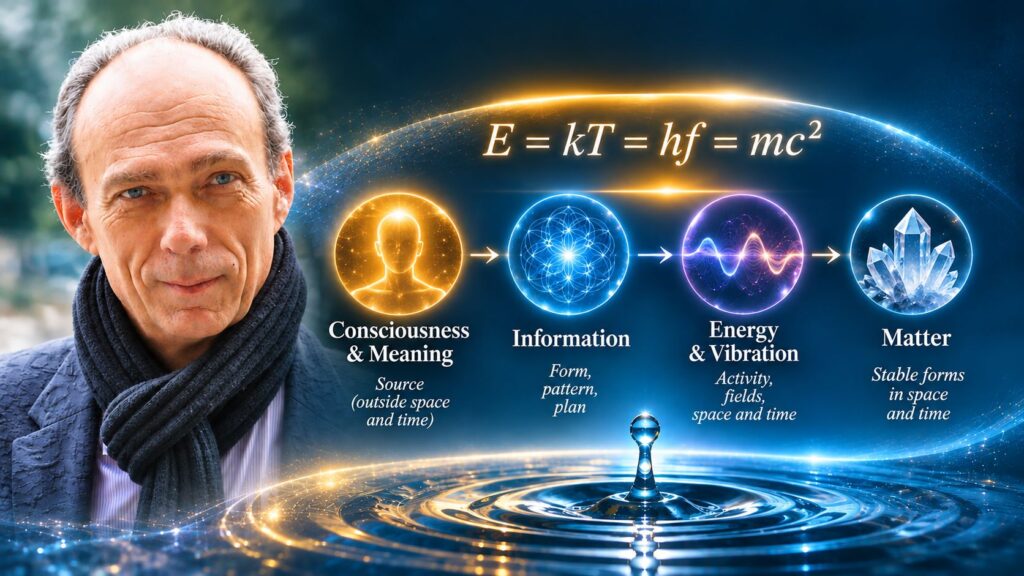
E = kT = hf = mc²
It says something simple. E stands for energy. The three expressions that follow are three ways in which energy shows itself.
The first, kT, is energy as heat. T is temperature, which tells us how fast molecules are moving. The letter k is Boltzmann’s constant, an exchange rate that converts degrees into energy, much as a currency rate converts euros into dollars. A cup of hot tea holds more of this energy than a cup of cold tea.
The second, hf, is energy as vibration. The letter f is frequency, the number of oscillations per second, and h is Planck’s constant, the exchange rate for vibration. Blue light vibrates faster than red light, and each particle of blue light therefore carries more energy.
The third, mc², is energy as mass. This is Einstein’s formula. The letter m is mass and c is the speed of light. It tells us that matter is energy in a very concentrated form. The Sun shines because it turns a little of its mass into light every second.
The equals signs say that these are three forms of one thing, and that any of them can be converted into the others.
Where is information? In the first term. Physics has found that heat and information are linked. To erase a single bit of information, one must pay a small and exact amount of heat energy, of the order of kT. This has been measured. Information has a price in energy.
Henry therefore read the line as follows: information, vibration and matter are three forms of the same thing. Consciousness is not in the equation. It is the one who reads it.
Four levels of reality
Put the chain and the equation together and a picture of reality in four levels appears.
The first level is consciousness, together with meaning, its first act. It is the source, and it lies outside space and time.
The second level is information: form, pattern, the plan of a thing before the thing exists. Bohm’s implicate order belongs here, and so do the archetypes.
The third level is energy and vibration. Here information becomes dynamic. Frequencies, fields and interference arise, and with them space and time.
The fourth level is matter: energy that has settled into forms our senses can register.
Henry added that these are states of one and the same principle. The closer a state lies to pure consciousness, the subtler it is. Moving away from the source, coherence falls: meaning, information, activity, inert matter. On the way back, coherence rises: crystals, living things, beings aware of the world, beings aware of themselves.
Readers of the Pythagorean tradition will recognise the Tetraktys: one, two, three, four, a source unfolding step by step into the manifest world. Henry reached the same figure from information theory and thermodynamics, without any reference to Pythagoras. That convergence is what first convinced me that the model deserves to be taken seriously.
Where does consciousness come from?
This is the most important question and the most delicate. Did Henry prove that consciousness comes first?
He offered several supports. The first is the computer argument described above. The second comes from Gödel, who showed that a formal system cannot fully describe itself from the inside. Giving meaning requires a system to refer to itself. If the brain is a computing system, there must be a blind spot in it, something present that cannot be represented from within. Henry saw that blind spot as the door through which consciousness enters the brain.
The third support is logic. Henry showed that the basic acts of thinking, such as denying, implying, joining and separating, can be built from one elementary logical operation. Depending on how contradiction is treated, three kinds of consciousness follow. Rational consciousness rejects contradiction. It is the waking, calculating mind, and classical physics is its language. Meta-consciousness tolerates contradiction. It works with symbols and meaning, as dreams do, and quantum physics behaves in the same way. Supra-consciousness gives contradiction no special status at all. It is the experience of oneness of which the mystics speak.
The fourth support is testimony. Planck, Schrödinger, Heisenberg, Wigner and Wheeler all concluded, each in his own words, that consciousness cannot be derived from matter.
These are good reasons. They are not a proof, and it is better to say so plainly. The computer argument shows that meaning needs an interpreter. It does not show that the interpreter existed before the universe. The argument from Gödel holds only if the brain is a formal system, which many dispute. The logical analysis describes how consciousness thinks, and the great physicists were giving their conviction. Henry himself wrote that his position was open to serious dispute and that he did not claim to settle a debate thousands of years old.
So consciousness is Henry’s starting point. His achievement is to show how much follows once it is granted: space, time, energy, matter, and numbers that can be checked. He answers the question of how consciousness reaches matter. For the question of why we should begin with consciousness at all, we need other sources. Philosophy supplies one: Bernardo Kastrup has argued that no account beginning with matter has ever explained experience, while an account beginning with mind explains matter with fewer assumptions. Direct experience supplies another, in the contemplative traditions and in the many people who have met consciousness without its usual contents. A third comes from observations that fit poorly into the materialist picture, such as lucid experience when brain activity is severely reduced.
The two kinds of argument need each other. Without Henry, idealism remains a philosophy with no path to the laboratory. Without philosophy and experience, Henry’s chain has no first link.
Water
If information is to act in matter, it needs a carrier. For Henry that carrier was water. Building on the physicists Giuliano Preparata and Emilio Del Giudice, he argued that part of the water organises itself into coherence domains: regions some hundred nanometres across in which about ten million molecules oscillate together, like a choir holding a single note. Such domains become stable at surfaces, along cell membranes and around the tiny bubbles that vigorous shaking produces. A domain can be coherent or not, and each state can stand for one bit. If every domain stores one bit, Henry calculated, the water shells of our cells could hold several hundred petabytes. These figures are estimates derived from the model. Nobody has measured them.
For homeopathy the consequence is direct. Avogadro’s number counts molecules. In Henry’s hypothesis, dilution removes molecules and leaves an ordered medium able to hold electromagnetic patterns, and succussion supplies the bubbles on which the order settles. He added that a remedy acts through similarity and meaning, which he linked with Jung’s synchronicity. It does not act as a cause pushing against an effect.
A larger space
In 2020 Henry asked where consciousness could sit within physics. He drew on a mathematical fact known since the early twentieth century: Maxwell’s equations, which describe light, possess more symmetry than four-dimensional space-time requires. The step from that symmetry to physical dimensions was his own. He proposed a fifth dimension of scale, which belongs to living beings, and a sixth, which he assigned to consciousness. He identified this larger space with the quantum vacuum, the ether that Einstein himself declined to abolish. Water is the interface through which information passes between that space and our material world.
Three ways of healing
A practical conclusion follows. In Henry’s model, healing could operate at three levels: with material drugs, with information carried by water or by electromagnetic fields, and directly through consciousness. Conventional pharmacology works at the first level. In my reading, the potentised remedy belongs to the second. Much of what our community is now exploring, from intention to noetic remedies, reaches towards the third.
How to hold his work
Coherence domains, water memory and the six-dimensional model are theoretical proposals, and most physicists and chemists do not accept them. The open question is whether coherence domains of the predicted kind can be demonstrated experimentally, and whether they can hold specific information with measurable biological consequences. Henry knew this. He published in a peer-reviewed journal, attached numbers to his claims and insisted that the model could be tested by physical and biological measurement.
His gift to us lies there. A chemist of high standing listened to two centuries of clinical experience and, instead of dismissing it, asked what kind of world would make it possible. His answer was a world in which consciousness is the source, information gives form, energy sets form in motion, and matter is where the movement comes to rest.
Sources:
J.-P. Gerbaulet and M. Henry, “The ‘Consciousness-Brain’ relationship”, Substantia 3(1), 2019, 113–118. M. Henry and J.-P. Gerbaulet, “A scientific rationale for consciousness”, Substantia 3(2), 2019, 37–54. M. Henry, “Consciousness, Information, Electromagnetism and Water”, Substantia 4(1), 2020, 23–36.
M. Henry, “What is reality in 2021?”, lecture for the Quintessence Forum, 20 October 2021.