
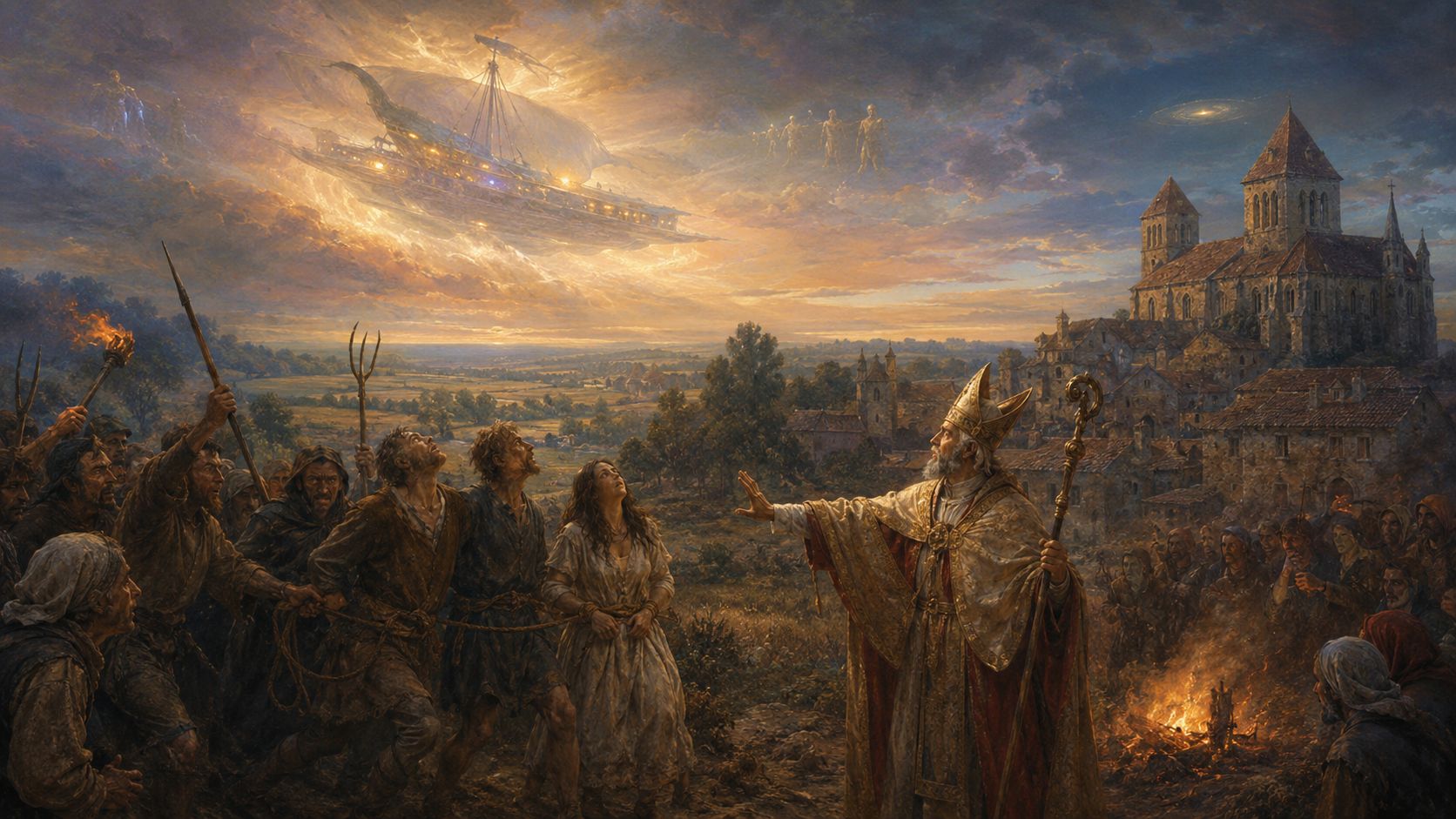
In the ninth century the people of Lyon dragged three men and a woman toward a fire. The crowd had watched them descend from the sky, and the verdict was immediate: these were weather-sorcerers in league with the men of Magonia, the cloud country whose ships sailed above the fields and carried off the harvest. The four prisoners protested that they were ordinary locals, taken up a short time before by miraculous men and shown unheard-of marvels. No one listened. They were saved only when Agobard, the bishop of the city, arrived, declared the whole affair impossible, and persuaded the mob that nothing of the kind could have happened. The people believed their bishop rather than their own eyes.
Jacques Vallée opens his catalogue of the marvelous with this scene because it contains, in miniature, the entire problem he spent his life describing. A phenomenon appears. Witnesses report contact with strange beings from a place that is somehow above or beside our world. The authorities, embarrassed, explain it away. And the explanation, however reasonable, settles nothing, because the same thing happens again in the next century under a different name.
Vallée was an astronomer and computer scientist who worked on the early mapping of Mars before he turned to the records of unexplained aerial phenomena. Passport to Magonia, first published in 1969, is the book in which he broke with the assumptions of his own field. The accepted question among serious investigators was whether flying saucers were machines from another planet. Vallée found that question too small. The reports he was reading did not begin in 1947. They ran backward through the airship sightings of the 1890s, through the apparitions of the Middle Ages, through the fairy lore of the Celtic countries, into the religious literature of every culture that left written records. The shape of the encounter stayed constant while the costume changed with the times.
The country called Magonia
The title comes from that medieval cloud country, and the book’s first movement traces how persistent the imagery is. The fundamental texts of most religions describe contact between humanity and a superior race that descends from the sky in luminous craft, surrounded by displays of light and sound. The chariots of God in the Hebrew scriptures number twenty thousand. Japanese chronicles record round objects of unusual brilliance hovering over Kyoto during periods of social unrest, frightening emperors and provoking executions. European writers of the sixteenth century catalogued bearded comets, flaming columns, duplicate suns, and dark ships in the sky, often linked to claims of contact with strange creatures.
By the early modern period the encounters acquire a philosophy. The hermetic writers had a whole theory of the elements and their inhabitants. Vallée reproduces a striking passage in which the Cabalist Zedechias, during the reign of Pepin, advises the Sylphs to show themselves openly in the air. They oblige in spectacular fashion, appearing in human form in battle array and aboard wonderfully constructed aerial ships. The populace concludes that sorcerers have seized the air to raise tempests, and the panic that follows is the panic that nearly burned the four prisoners at Lyon. Paracelsus devoted a book to these beings and warned his readers against any compact with them. In 1491 the physician Facius Cardan recorded a visit from seven men in silken garments and shining shoes who debated theology with him and then vanished. The detail that one of them offered, that God creates the universe from moment to moment and would let it perish if he paused for an instant, anticipates a thought that physics would not reach for four hundred years.
The point Vallée draws from all this is not antiquarian. The witnesses are describing the same encounter we describe now. The metaphysics attached to it shifts with the available vocabulary. The encounter itself does not.
The secret commonwealth
The strongest parallel runs through the fairy-faith of the Celtic countries, and here Vallée found his most useful guide in a Scottish minister. In 1691 Robert Kirk of Aberfoyle gathered every account he could find of the Sleagh Maith, the Good People, and wrote The Secret Commonwealth of Elves, Fauns and Fairies. It was the first systematic attempt to describe the organization and habits of these creatures, and tradition holds that the Good People took Kirk himself shortly after he finished it.
Read Kirk’s findings against a modern encounter file and the correspondence is hard to dismiss. The fairies occupy a nature between man and the angels. Their bodies are light and fluid, comparable to a condensed cloud, most visible at dusk, able to appear and vanish at will. They live inside the earth and reach the surface through any opening where air passes. They can carry away anything they like. Their dwellings are large and beautiful and lit by lamps that burn without fuel. They speak among themselves in a kind of whistling sound and adopt local speech when they address humans. Their philosophy holds that nothing dies, that all things move through cycles and return renewed, that motion is the universal law. They keep a hierarchy of leaders and show no devotion to any God.
The beings reported in the twentieth century fall into the same biological catalogue. There are giants, men indistinguishable from us, winged figures, and a range of monsters, but the typical pilot is a dwarf. Vallée sorts the dwarfs into two old categories. The first are dark, hairy, with small bright eyes and deep rugged voices, the gnomes of medieval theory exactly. The second have human complexions, oversized heads, and silvery voices, the sylphs and elves of the fairy-faith. The terminology of the elemental philosophers maps onto the field reports of the saucer age with a precision that no one designed.
To Magonia and back
The folklore also recorded what happened to the people who were taken, and the modern abduction account did not invent its details. Walter Evans-Wentz noted that the mind of a person returning from Fairyland is usually blank as to what was seen there. Vallée sets that observation beside the case of Gerry Irwin, a missile technician who stopped his car in Utah in 1959 to investigate what he took for a burning aircraft, was found unconscious, and recovered with a hole in his memory. Weeks later, following an urge he could not explain, he walked away from his post, returned to the exact spot, and went straight to a bush where his jacket lay, burned a slip of paper hidden there, and came out of the trance not knowing why he had come. He deserted soon after and was never seen again. The Betty and Barney Hill case, recovered under hypnosis, belongs to the same family.
Time behaves strangely in these accounts, as it always did in the old tales of those who spent a night under the hill and returned to find their friends grown old. Vallée treats this not as decoration but as the hardest part of the data. The structure of time is as much a puzzle to modern physicists as it was to Reverend Kirk, and any theory of who might visit us that ignores our ignorance on this point remains an academic exercise.
The functional absurdity
The feature that drove serious scientists away from the subject is the one Vallée found most revealing. The behavior of the entities is consistently absurd. Their craft are described in ludicrous detail, full of tubes and antennae and ladders. Their messages are trivial or misleading. They warn farmers about fertilizer, demand to know the time, repair their machines with comic gestures, and deliver pronouncements that lead nowhere. This holds for every case on record, from the Gentry of the British Isles to the airship engineers of the 1897 American flap to the alleged Martians reported in Europe, North and South America, and beyond.
Vallée’s reading of this absurdity is the intellectual core of the book. The organized action of a superior order would not necessarily look purposeful to those below it. We share the planet with animals and insects whose activities interweave with ours despite the gap in the organization of their nervous systems, and a fly has no model of human purpose. A scientist who dismisses the reports because intelligent visitors would not behave so strangely has simply not thought about what nonhuman intelligence might be. The absurdity is not a flaw in the phenomenon. It is doing work. It keeps the careful and the powerful at a distance, and it clothes the whole affair in religious and mystical feeling.
This leads to the claim that gives the book its lasting charge. Human action rests on imagination, belief, and faith far more than on objective observation, and this is true of science as much as of religion. To shape what a population can imagine is to shape its destiny, provided the source of that shaping stays hidden. Governments and advertisers already understand this, which is why both take such interest in folklore. Vallée is careful to say he is not claiming the phenomenon is a human trick. He is claiming something more unsettling: whatever produces it functions as a control system for human belief, adjusting its displays to the culture and superstitions of each time and place, and affecting believers and skeptics alike.
The evidence for the adjustment is in the data. The entities behave like science-fiction monsters in the United States, like aggressive fighters in South America, like rational Cartesian tourists in France. The Irish Gentry presented itself as an aristocratic order. The airship pilots of 1897 had the manner of American farmers. The myth wears local clothing everywhere it appears.
Five facts and a sculpture in Chicago
Vallée closes by refusing the easy conclusions. He lists the attractive theories one by one, including the idea that some superior intelligence has been projecting artificial objects into our environment as a pure form of art, enjoying our puzzlement the way a sculptor might. He compares us to the birds that perch on the Picasso in Chicago, shaped by an art they cannot read, and remarks that the great UFO Master shapes our culture while most of us never notice. Then he withdraws the theories, because none of them has a scientific leg to stand on, and shows how easily one slips into pure fantasy the moment the discipline of the facts is dropped.
What remains are five observations he treats as solid. There has been a continuous generation of close-encounter reports across all countries since 1946. When the underlying archetypes are extracted, the saucer myth coincides with the fairy-faith and with the observations of earlier scholars. The reported beings fall into stable biological types that match the old categories. Their behavior is consistently absurd in a way that repels investigation. And the mechanism of the apparitions follows the model of religious miracle, to the point where certain events bearing the official stamp of the Church differ from a saucer landing only in the content of the message delivered.
From these he allows three propositions. The conduct of a nonhuman intelligence need not look purposeful to us. Any account of who could reach us is worthless until we understand the nature of time. And the entire pattern carries every element of a myth that could be turned to political or social use, which the steady tracking of the reports against the progress of our own technology already hints at. He ends without a solution, with a short admission from Jerome Cardan that whether the thing be fact or fable, so it stands, and with a few lines from Milton that he leaves the reader to find.
Why this belongs in our conversation
For a forum concerned with the development of paradigm and the relationship between consciousness and reality, Passport to Magonia repays a slow reading. Vallée is not arguing for spaceships and not arguing for spirits. He is describing a phenomenon that sits exactly where the materialist frame goes blind, a phenomenon that adapts itself to what the observer is prepared to believe and leaves physical traces while refusing to behave like ordinary matter. His Fact 2 reaches for the word archetype, and the bridge to Jung is built into the book itself. The saucer, the elemental, the angel, and the fairy are surface forms of something deeper that presents itself through whatever images a culture has ready.
That is a familiar structure to anyone who works with the idea that substances carry meaning and that a remedy can open onto the pattern behind it. The encounter changes its costume and keeps its grammar. The witnesses across the centuries are reading the same text in different scripts. Vallée’s modesty about the solution is the right note to end on. We cannot be certain we are studying something real, because we do not yet know what reality is. We can be certain the study tells us a great deal about ourselves, and that is not a small return.

